Useful places to learn AI without drowning in tools, hype, or bad advice.
AI advice is everywhere. Some of it is useful. Some of it is a LinkedIn carousel claiming to be your next big breakthrough. For coaches, the problem is exaggerated because coaching is personal: clients share sensitive information, trust is a priority, and the human side of the work must remain fundamental.
Generic AI tips can help you write prompts and create content faster. Fine. But that is a long way from building a better coaching business. You need resources that help you systemise your expertise, automate repeat tasks, support clients between sessions, and fill your client pipeline without wasting months playing with tools.
Here are the resources worth knowing about, starting with the ones built specifically for coaches.
AI is moving quickly, and the loudest advice is rarely the most useful. A coach needs guidance that turns AI into better systems, better client support, and better lead generation.
Your clients are already using AI in other parts of their lives. They can get instant answers, personalised suggestions, draft plans, summaries, reminders, and feedback in seconds.
That changes the standard. A monthly coaching call is still effective, but it cannot be the only way your expertise shows up. The right AI resources help you see where AI can support the client experience without replacing the coach.
Coaching is built on trust. Clients share personal goals, business problems, habits, doubts, and sometimes sensitive information. You cannot treat that like a generic “AI for productivity” use case.
Good AI guidance for coaches should cover confidentiality, transparency, client boundaries, data handling, and reputation risk. If a resource only teaches you how to write LinkedIn posts faster, it is useful but incomplete.
Reading about AI can make you feel productive. It is not the same as improving your business.
The best AI resources for coaches help you build something useful: a sharper content system, a better lead magnet, an AI version of your methodology, a client support asset, or an automated workflow that saves you time. That is where AI starts to make a commercial difference.

You do not need to follow every AI newsletter, tool launch, and prompt thread. Start with resources that help you make better decisions about your coaching business.
The best place to start is The AI-Powered Coaching Business Playbook by Jodie Cook.
It has already been read by thousands of coaches and consultants who want a clearer way to use AI in their business.
The playbook is built around five parts of an AI-powered coaching business: digital assets, social media content, your AI version, a second brain, and automations. That makes it useful for coaches who want to move past prompt tips and understand how AI can support a more scalable business model.
It is especially useful if you already have strong methods, client results, and a body of work, but your business still depends too heavily on your calendar. The playbook helps you see what to build first, where your existing IP can be used, and how AI can start turning your expertise into assets that work beyond one-to-one calls.
Once you have read the playbook, Coachvox Academy is the obvious next step. It turns the model into an implementation process, so you can stop collecting ideas and start building the system.
It is currently included with an annual Coachvox subscription and takes coaches through a five-session process for building an AI-powered coaching business. Across the programme, you work on the key parts of that ecosystem, including your AI version, digital assets, content, lead generation, automation, and the way those pieces connect.
There are also three bonus marketing sessions, which is important because AI alone will not fill your client pipeline. Coaches still need positioning, content, offers, lead capture, and follow-up. Academy connects the AI work to the commercial side of the business, so you are not left with a clever tool and no plan for using it.
The AI for Coaches LinkedIn newsletter is a useful way to stay current without turning AI research into another job.
It breaks down recent AI developments, coaching-specific use cases, and practical ways to apply AI inside a coaching or consulting business. That makes it a good follow-up resource once you understand the bigger model and want regular reminders, examples, and ideas.
Use it as a light-touch update source. Read it, save what is relevant, and turn one useful idea into an action before you go looking for the next one.
The Coachvox blog is a comprehensive resource library. It gives you a way to go deeper on specific parts of using AI as a coach without trying to learn everything at once.
You can use it to explore topics such as AI lead magnets, product ecosystems, ChatGPT prompts, content creation, automations, and client support. This is especially useful when you have already chosen what you want to improve and need a more focused article.
The easiest way to use the archive is to start with your current bottleneck. If lead flow is the issue, read about AI lead magnets. If your calendar is full, read about client support and scalable delivery. If your content is inconsistent, start with AI content creation.
The International Coaching Federation is trusted place to look for guidance on responsible AI use in coaching. Its AI coaching framework gives coaches a reference point for ethics, transparency, confidentiality, bias, and client trust.
This is especially relevant if you hold an ICF credential, work with corporate clients, or coach on sensitive topics. You want to know how AI can support your work without creating avoidable risk.
It also links naturally to wider accreditation questions. If you care about professional standards, it is worth reading alongside resources on coaching accreditation bodies, Coachvox as an ICF business partner, and Coachvox Academy’s ICF CCE accreditation.

A general AI newsletter is useful for staying aware of what is changing. New models, features, tools, and use cases appear quickly, and you do not want your understanding of AI to be six months out of date.
Keep this in its proper place. A general AI newsletter can help you spot trends and understand what is becoming possible. It should not become your main source for how to build an AI-powered coaching business.
Pick one you actually read. Skimming five newsletters every morning is not a strategy. It is a very efficient way to feel busy before doing no implementation at all.
AI tool directories can help you see what exists across content, automation, research, design, video, productivity, and customer support.
Use them with discipline. Start with the business problem, then look for the tool. If you browse tool directories with no clear aim, you will lose an hour, sign up for three free trials, and somehow still not improve your coaching business.
For coaches, the best question is simple: does this tool help me save time, serve clients better, generate better leads, or turn my expertise into something more scalable? If the answer is no, it can wait.
Start with the outcome you want. Do you want better content, stronger lead generation, more support between sessions, a more scalable offer, or a cleaner internal system? The best resource depends on the part of your business you are trying to improve.
If you are still exploring, start with the Playbook. If you want to build, move into Coachvox Academy. If you want standards and ethics, read the ICF framework. If you want wider awareness, follow one general AI newsletter. Keep the path simple, otherwise AI research becomes another form of procrastination with better branding.
The right resource should leave you with a decision, an asset, or a next step. If all it gives you is more tabs open, close them.
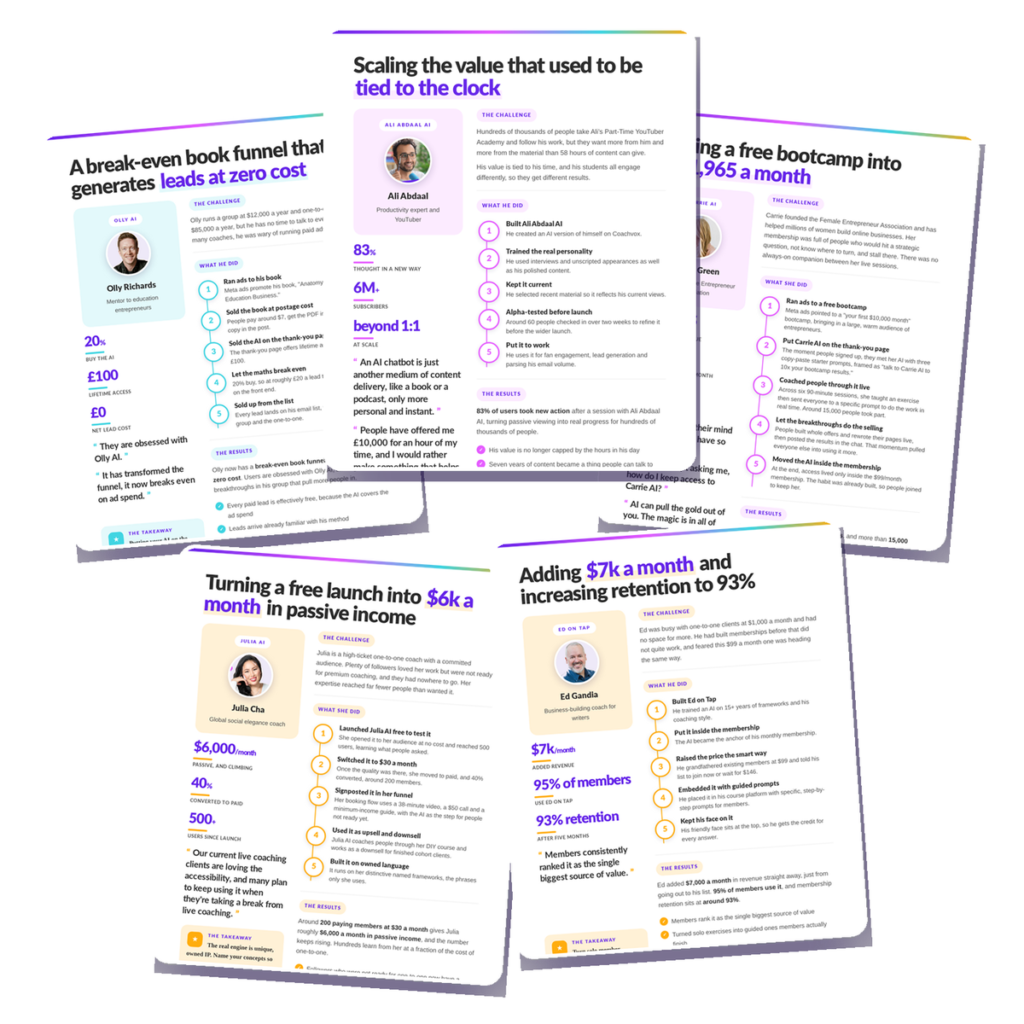
Coachvox gives you the software, training, and community to turn your expertise into something clients and prospects can use around the clock. You can build your AI version, connect it to your wider business, and learn the AI skills that actually support growth.
With Coachvox, you can:
Start your free trial and see what your expertise can become with the right AI system behind it.
AI is moving too quickly for coaches to sit on the sidelines waiting for the perfect moment. The useful resources help you understand enough, choose a direction, and make progress without getting buried in tools.
A good resource respects coaching, gives you a clear path, and helps you build something your clients, prospects, or business can actually use.
The best AI resources for coaches understand coaching as a profession and show how AI can support the business behind the coaching. Start with The AI-Powered Coaching Business Playbook, Coachvox Academy, the AI for Coaches LinkedIn newsletter, the Coachvox AI blog archive, and the ICF AI coaching framework.
A good mix gives you implementation, ethics, examples, and wider AI awareness.
Coaches can learn AI by focusing on business use cases. Start with what you want AI to improve: content, lead generation, client support, automation, or internal systems.
You do not need to code or understand model architecture to use AI well. You need to understand where AI fits inside your coaching business.
Coaches should first learn how AI can support their business while protecting client trust and the human side of coaching. That means understanding the scope of prompting, automation, content creation, and AI-powered client support as well as data handling and client boundaries.
Start with one clear use case. A coach who tries to learn everything at once will usually end up with more tabs open than progress made.
Yes, Coachvox Academy is a strong and trusted AI resource for coaches who want to build an AI-powered coaching business. It gives coaches a structured implementation path covering their AI version, digital assets, content, lead generation, and automation.
It is currently included with an annual Coachvox subscription and is accredited by the ICF for CCE points, making it a solid choice for serious coaches.
Coachvox helps coaches learn AI by giving them the software, training, and community to build with it. Coaches can create an AI version of themselves, train it on their content and methodology, and use it for lead generation, client support, content creation, and scalable delivery.
That makes the learning practical. Every part of the process is tied to building a working asset for your business.
Generic AI newsletters are useful for staying aware of new tools, model updates, and wider AI trends. They help you understand what is changing across AI more broadly. However, the risk is you get inundated with and distracted by a range of tools not suited to your specific use case.
Use one good general newsletter for awareness. Use coaching-specific resources such as the AI for Coaches LinkedIn newsletter when you want to apply AI to client support, trust, lead generation, or your coaching methodology.
Some coaches may benefit from an AI coaching certification, especially if they want formal training, structured practice, or a credential they can show clients. It is worth exploring if your work involves corporate clients, regulated environments, or sensitive client issues.
The majority of coaches will get faster value from a practical programme, a coaching-specific AI framework, or building their own AI-powered assets.
The best way for coaches to stay up to date with AI is to choose a small set of reliable resources and review them regularly. One coaching-specific newsletter, one wider AI newsletter, and one practical resource library is usually enough.
The goal is to keep your knowledge current without turning AI research into another weekly distraction.
Coaches can use AI ethically by being clear about when AI is being used, protecting client data, avoiding careless uploads of sensitive information, and keeping human judgement in charge of important coaching decisions.
The ICF AI coaching framework is a useful reference point for coaches who want guidance on transparency, confidentiality, bias, and responsible use.
A useful AI resource should help you make a decision, improve a process, or build an asset. It should connect AI to real business outcomes such as better lead generation, stronger client support, content creation, automation, or scalable delivery.
If a resource gives you interesting ideas but no next step, read it once and move on. Your main learning path should help you build.