How to package your expertise into a connected set of offers that works for your business around the clock.
Most coaching businesses are built around one thing: the coach showing up live. Whether that’s on Zoom, over the phone, or in a room, the model is the same. You deliver the session, the client gets the value, and then you do it again with the next person. That model works. It’s personal, high-touch, and for many coaches it produces real results. But it also has a ceiling.
Digital products give you a way to move beyond that ceiling without walking away from the work you love. They let you package your knowledge, methods, and tools in ways that keep delivering value. Many coaches hear “digital products” and immediately think online courses, but that’s too narrow. A well-built digital product can teach, support, qualify, and sell.
The real opportunity comes when these products start working together as a connected ecosystem. This article covers what digital products for coaches actually are, why they’re becoming essential, the main types worth building, and how to connect them into something that actively grows your business.
Digital products for coaches are structured, repeatable ways to deliver your knowledge, frameworks, tools, or support without needing to be present in real time.
That covers a lot of ground. We’re talking about recorded programmes and courses, templates, workbooks and playbooks, paid communities and memberships, mini-trainings, and AI-powered coaching tools. Some of these sit at the top of your offer stack as free or low-cost entry points. Others are substantial paid products in their own right.
Many coaches still see digital products as something other people do, course creators, online educators, influencers. But as we’ll cover in the next section, they’re fast becoming an essential part of how modern coaching businesses are built and scaled.
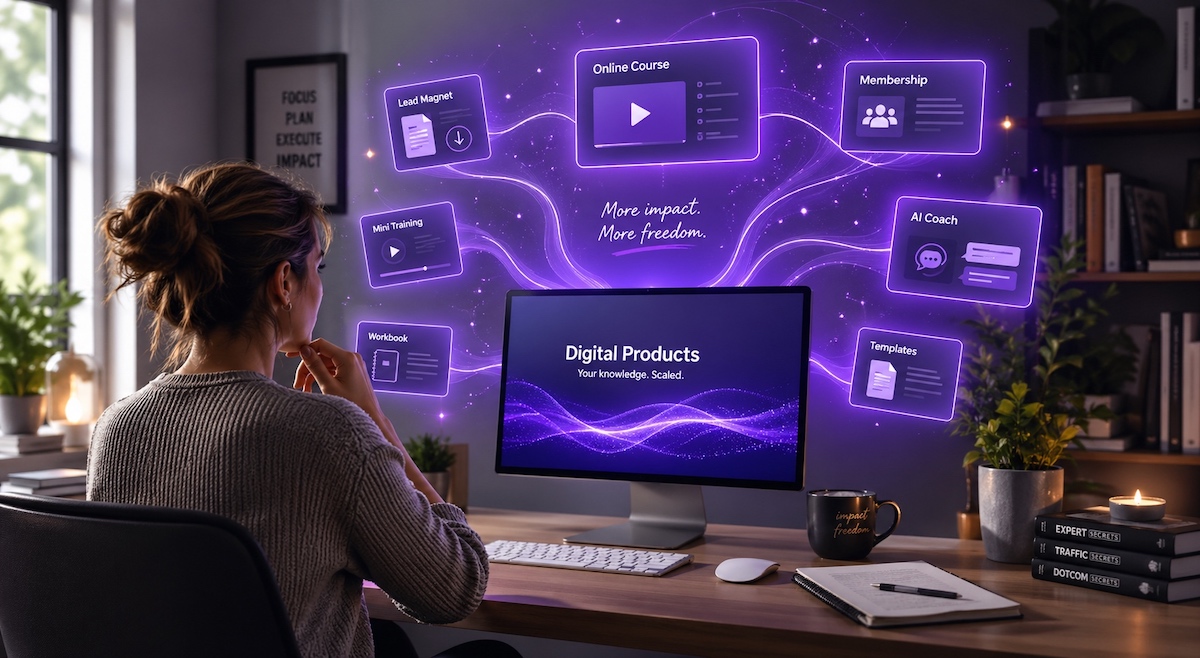
Building a coaching business around digital products opens up new ways to attract clients, support them more effectively, strengthen your positioning, and create income that isn’t tied to your calendar.
1:1 coaching ties your revenue directly to your available hours. There’s a hard limit on how many sessions you can deliver before quality, energy, or lifestyle starts to suffer, and raising prices only gets you so far. At some point, the model itself becomes the constraint.
A digital product can sell to ten people or ten thousand without the unit economics changing. That’s a fundamentally different relationship with revenue, and it’s one that gives coaches the ability to grow their income in ways that 1:1 delivery simply can’t match.
But it’s not just about revenue. Most coaches have more to offer than 1:1 or small group coaching. Digital products let you support people at different stages of readiness and different price points without adding a single extra call to your week. Someone who can’t afford your premium rate can still access your methods and approach.
More people get access to your expertise, at a price point that works for them. And your business grows without being contingent on how many hours you can give.
Digital products can make your coaching more effective, not just your business more efficient. Clients get access to support and structure between sessions, can revisit key lessons instead of relying on memory, and arrive at live calls better prepared and more focused.
This creates continuity that most coaching businesses otherwise lack. And when clients get better results, they stay longer, refer more, and become the kind of social proof that builds your reputation.
Digital products make your expertise more tangible. A structured course, toolkit, or AI coach shows that your methodology exists in a real, documented form, which makes you look more established and credible to prospective clients.
They also strengthen your pricing. Including a premium product as part of a higher-ticket offer makes that offer feel more substantial, and gives buyers more reasons to say yes. Digital products can effectively act as coinage in your business, assets you can use to increase perceived value without increasing delivery time. For example, including a “$3,000 course” inside a programme changes how that offer is perceived, even though your time commitment stays the same.
A coaching business built only on 1:1 delivery is vulnerable. Capacity limits, cancellations, and inconsistent lead flow can all put pressure on revenue with very little buffer.
Digital products create more entry points into your world, more ways to sell, more ways to build trust, and less reliance on any single part of your business model. When one area slows down, the others keep moving.
You’re probably already sitting on the raw material needed to create several of these digital products. The question is which ones to build, in what order, and how to position them.
A lead magnet is a free resource you offer in exchange for someone’s contact details. Its job is to attract the right people into your world and give them an early taste of how you think and work. A good one solves a specific problem quickly, and leaves the reader wanting more.
For coaches, this could be a checklist, a short guide, a scorecard, a mini video training, or a free challenge. The format matters less than the relevance. If it speaks directly to the problem your ideal client is trying to solve, it will build your email list.
Some coaches are now using an AI coaching tool as their lead magnet, giving prospects free access to a version of their thinking and methodology before they ever book a call. It’s a more interactive entry point than a PDF, and it builds familiarity in a way that static resources rarely do.
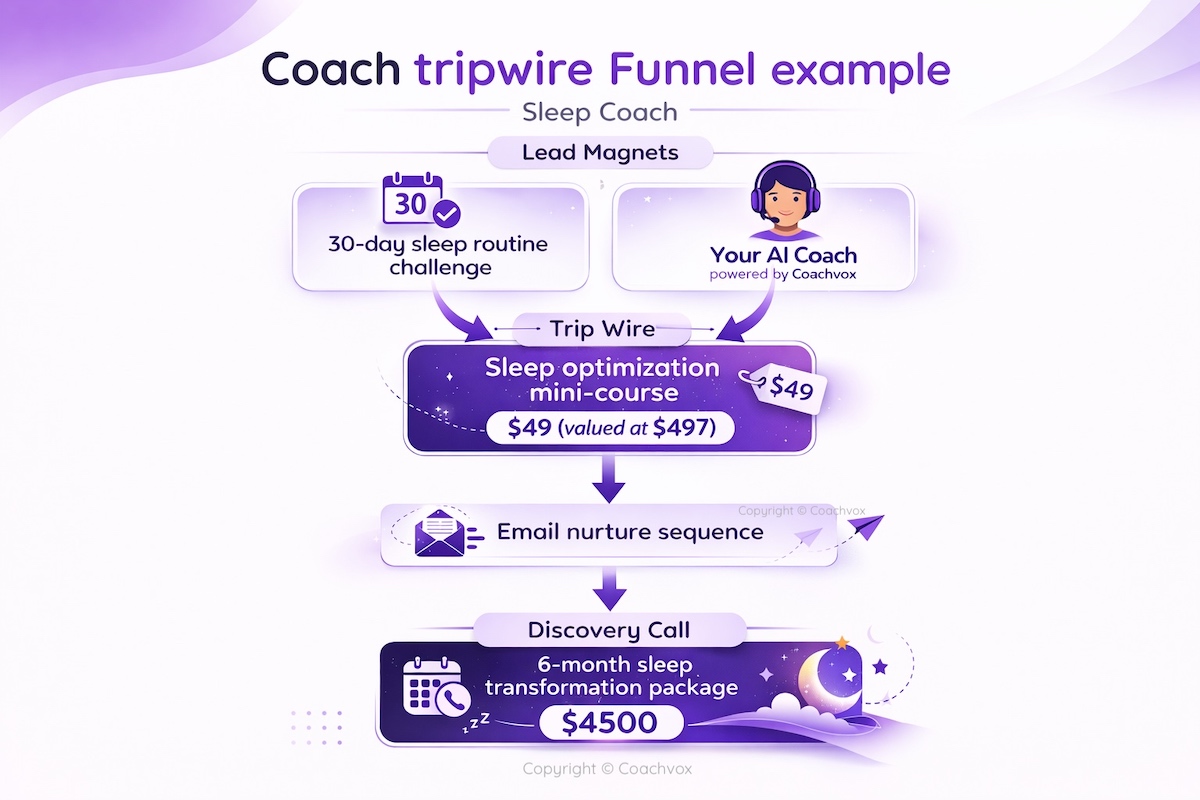
A tripwire is a low-cost paid product, typically somewhere between £7 and £97, designed to turn a new lead into a buyer as quickly as possible. The price point is low enough to be an easy decision, but the act of buying changes the relationship. Buyers behave differently from free subscribers.
This could be a workshop recording, a focused mini-course, a swipe file, or a tactical guide that solves one clear problem. The primary goal isn’t to make significant revenue but to qualify your audience and open the door to your bigger offers.
A strong tripwire also builds confidence in your paid products. If someone buys a £19 resource and finds it genuinely useful, saying yes to a £497 programme feels like a much smaller leap.
A course or programme is your most substantial digital product. It takes someone through a defined process, from where they are now to a specific outcome, without you needing to be in the room. That could be a self-paced video course, a structured written programme, or a series of recorded sessions built around your methodology.
The best ones are built around what you already do. Look at the themes you return to repeatedly in your coaching, the ideas you explain, the shifts you help people make. A course doesn’t have to mirror your 1:1 offer exactly, just sit within the same territory and deliver something your clients genuinely want.
Don’t be afraid to be generous with what you put in. A $2,000 course that over-delivers will generate the kind of testimonials that sell the next cohort for you. People will always pay for personalisation and direct access, so giving away a lot of your knowledge in a course doesn’t devalue your coaching.
Once someone has bought from you, they’re far more likely to buy again (exactly the same as tripwire funnel psychology). Upsells and add-ons are how you increase the value of each client relationship without starting the sales process from scratch every time. If someone wants to get more of you, give them that option!
These could be templates, advanced training modules, a done-with-you resource, or access to a private community. They can be offered immediately after a purchase, bundled into a higher-tier package, or made available as clients progress through your work.
A Coachvox fits naturally here too, as a premium add-on that gives clients access to your thinking between sessions, making your higher-ticket offers feel even more substantial. Remember, you can provide add-ons for free as a bonus or coinage.
Continuity products create recurring revenue by keeping clients in your world after an initial purchase or coaching engagement ends. A membership, a group programme that renews, or an ongoing community with regular content all fall into this category.
These are worth building because they stabilise your income and deepen client relationships over time. Someone who stays subscribed to your community for six months will know your work far better than someone who bought a single course. That familiarity makes the conversation about working with you more closely a much shorter one.
The best coaches are building an ecosystem using digital products, where each offer connects to the next and every product has a job to do. A lead magnet brings someone into your world, a tripwire turns them into a buyer, a core course or programme delivers real transformation, an upsell adds depth, and a continuity product keeps them engaged long term. Your 1:1 or group coaching sits at the top, reserved for people who want direct access to you.
Not every client will move through every stage. Some will buy your tripwire and nothing else. Others will go straight from your lead magnet to your highest-ticket offer. The ecosystem doesn’t force a single path, it just makes sure there’s always a logical next step available, whatever stage someone is at.
When products are connected, each one does more than its own job. Your lead magnet feeds your tripwire. Your course creates clients who are primed for 1:1 work. Products at different price points create contrast, making your higher-ticket offers feel more considered and your entry-level ones feel genuinely accessible. Multiple products at multiple price points means multiple ways for the right person to say yes.
You now know what a coaching product ecosystem looks like and what each component does. The next step is building one that actually works for your business, attracts your ideal clients, and grows your revenue.
Start with what is already happening in your business. Look at your clients and the problems you solve again and again. The same questions come up, the same sticking points show up, and you guide people to similar outcomes. Repetition is your signal. If you are explaining the same idea across multiple clients, you are already sitting on something that can be packaged.
You already have a way of thinking. You might not have written it down formally, but it is there in how you structure conversations and guide decisions. Make that visible. Turn your approach into something clear someone can follow without you in the room. This could be a sequence, a model, or a simple set of steps. Once your thinking is structured, it becomes far easier to turn it into a digital asset.
Keep your first move tight. You do not need a full programme to get started. A focused product that solves one clear problem will get you further, faster. For most coaches, that means a lead magnet or a low-cost tripwire. It gives you immediate feedback and shows you what people are actually willing to engage with. Pick something relevant, build it quickly, and get it in front of your audience.
Simple wins here. A product that is clear and easy to use will outperform something bigger that tries to cover too much. Focus on one outcome and remove anything that does not directly support it. Don’t try and prove how much you know; you are helping someone get a result. The tighter the product, the more likely people are to complete it and get value from it.
Every product should lead somewhere. Think about what happens next once someone has used it. Does it point towards another product, a programme, or a conversation with you? When your products are connected, they start working together. Entry-level offers build trust, core products deliver results, and higher-ticket offers provide depth. That structure makes it easier for the right people to keep moving forward with you.
Get it out there. Once it delivers value, it is ready. You will learn far more from real users than you will from refining it in isolation. Watch how people use it, notice where they get stuck, and pay attention to what they ask for next. Then improve it. Strong products are built through iteration. Keep it moving and keep improving it based on real usage.
Want to turn your digital products into something more valuable?
Coachvox gives you a way to go beyond static content and bring your methodology to life inside your products. Instead of relying on videos, PDFs, or templates alone, you can give your audience access to an AI version of your thinking that responds, guides, and supports them in real time.
With Coachcart, you can package and sell that experience as part of your product ecosystem. Add your AI coach into a lead magnet, include it inside a course, offer it as a paid add-on, or use it to strengthen your higher-ticket programmes. It becomes another layer of value that works for your clients without taking more of your time.
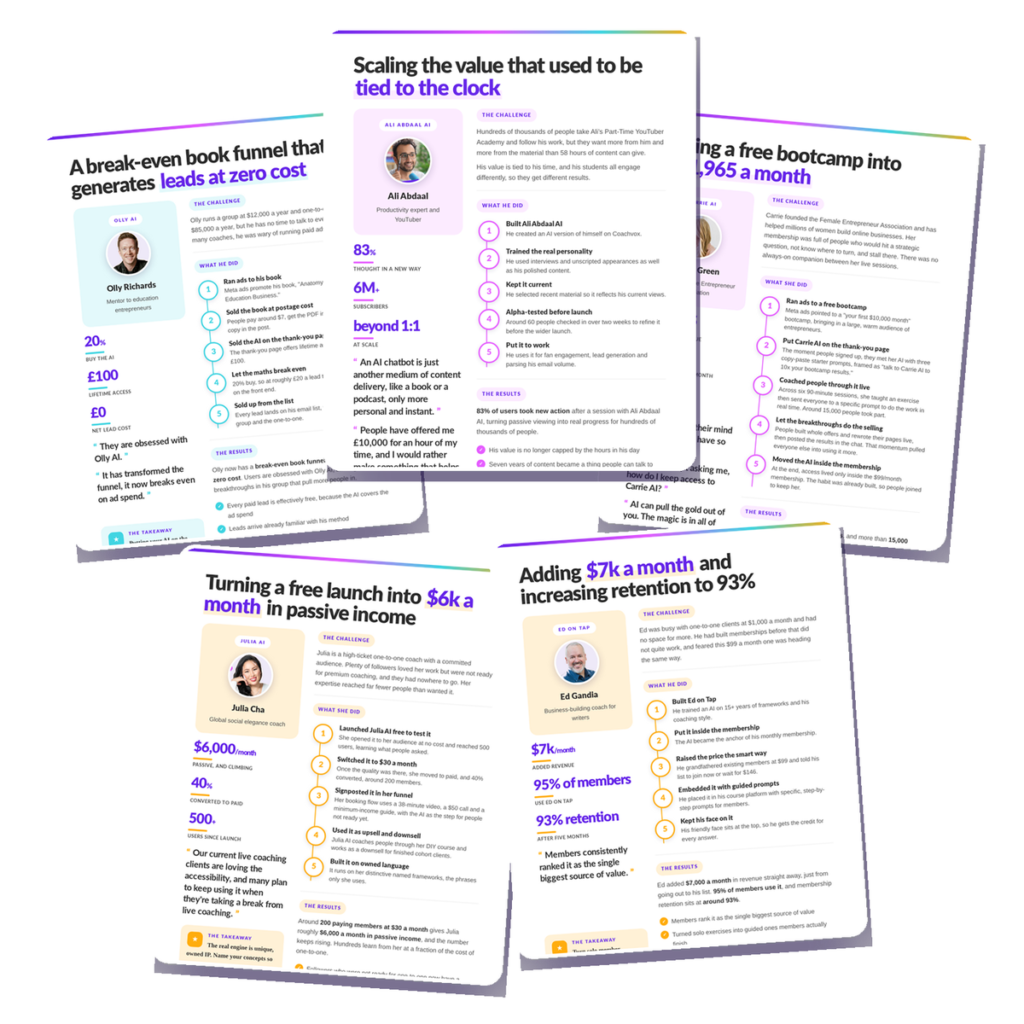
Coaches are using Coachvox to:
Try Coachvox today for free and see how an AI-powered product can fit into your coaching ecosystem:
A smart product ecosystem gives your coaching business an edge. Each product has a role, from attracting attention to building trust to delivering results at scale. It creates more ways for people to engage with your work and more ways for you to generate revenue without relying on your calendar.
You can serve clients at different stages, from those just discovering you to those ready for deeper, higher-ticket work, all within the same connected system. At the same time, it strengthens how you are perceived. When your ideas are packaged into clear products, your expertise becomes easier to see, understand, and value.
Tools like Coachcart make a difference. You no longer need a long build process to create something useful and sellable. You can package your thinking, connect it to your offers, and put it in front of your audience quickly. Test, learn, and improve without friction. The sooner you start building your ecosystem, the sooner it starts working for you.
A focused lead magnet or a simple paid resource is usually the easiest place to start. Choose one specific problem your audience cares about and create a short, useful solution such as a checklist, guide, or mini-training. Keep scope narrow so you can build and launch quickly.
No, but you do need access to the right people. You can validate ideas with a small audience, existing clients, or even direct outreach. What matters is relevance, not size.
Look at what your audience is already asking and paying for. Repeated questions, common bottlenecks, and past client work are strong indicators. If people already pay you to solve a problem, there is demand.
Yes, and they often strengthen high-ticket offers. They help build trust before a sale, improve client results during delivery, and increase perceived value when included as part of a programme.
They sit before, during, and after your main offer. They can attract leads, convert buyers, support delivery, and retain clients over time. This creates a more complete and efficient sales system.
A course delivers structured content, while a coaching programme adds guidance and accountability. Courses are usually self-paced, while programmes often include support, feedback, or live elements. Both can sit within the same ecosystem.
It depends on scope, but most first products like a lead magnet or tripwire can be built in a matter of hours or days. Starting here allows you to test and improve based on real feedback.
A mini course or even a full course takes longer to put together, especially if adding resources to modules. This could take a couple of weeks and then another couple of weeks to run the promotion or for a successful launch.
You only need a way to create, host, and sell your product. This can be as simple as a document tool, a video platform, and a checkout system. Specialist tools like Coachcart are developed specifically with coaches in mind, and makes set-up, sale, and delivery incredibly straightforward.
Price should reflect the problem solved and the role of the product. Tripwires should be a no-brainer price and represent incredible value for money, think $9 to $99.
Entry-level products are priced low to encourage action and tap into more price-sensitive members of your audience. Range: $49 to $297.
More advanced products can command higher prices based on outcomes and depth. Course or programmes could be $500-$5000+.
Yes, and it is often a smart move. The same product can be sold on its own, included in a bundle, or used as part of a higher-ticket offer to increase perceived value.
Focus on clarity, structure, and a clear outcome. Keep the product easy to follow, remove unnecessary content, and guide the user towards a specific result. For higher-ticket products, schedule email check-ins after a few days to keep students accountable.
AI can make digital products more interactive and responsive. Instead of static content, clients can engage with your thinking in real time, ask questions, and get guidance that feels personalised. Create your Coachvox here.
Yes, they can qualify and educate prospects before a conversation. When someone has already engaged with your content or bought a product, they arrive better informed and more ready to decide.
Clear roles, strong connections, and a logical progression between offers. Each product should lead somewhere, support the next step, and make it easier for the right clients to continue working with you.