Use proof, content, and digital assets to build buyer trust before prospects ever speak to you
Your coaching is rock solid. Your clients get results. People who have worked with you trust you already. The harder part is building that same trust with people who have never met you, never sat on a call with you, and have only seen fragments of your work online.
That is where the problem gets misdiagnosed. A quiet pipeline, lukewarm enquiries, or friendly discovery calls that go nowhere can make it look like you need more marketing. Sometimes you do. But if people are seeing your work and still hesitating, the missing layer is trust at scale: the proof, content, credibility markers, and digital assets that help strangers become followers, and followers become buyers.
This article will show you how to build that trust before prospects ever speak to you.
A thin pipeline makes marketing look guilty. The numbers are down, enquiries feel patchy, and discovery calls take more effort than they should. The obvious answer is more content, more traffic, or a better funnel. But, before you throw another thousand dollars into Meta ads, let’s double check.
Marketing gets people to notice you. It can put your name in their feed, send them to your website, or get them onto your email list.
That does not mean they trust you enough to give you their money.
For coaching and consulting, attention is only the first step. A prospect can like your post, read your page, or watch your video and still feel unsure about whether you are the right person to help them. If your public presence does not show enough proof, depth, and evidence of how you think, more visibility just creates more people who know your name but do nothing with it.
High-ticket coaching carries more perceived risk than a prospect can resolve from a sales page. They are weighing up the money, the time, the personal exposure, and the risk of picking the wrong person.
It feels like weak marketing. Prospects may click, follow, read, and book, then slow down when the decision starts to feel real. Your marketing created the contact, but the trust signals have not made the decision feel safe enough yet.
A deadline, bonus, or sharper follow-up email will not fix that on its own. The prospect needs enough proof, familiarity, and confidence to believe your coaching is worth the commitment.
When discovery calls do not turn into clients, it is easy to blame the call, the script, the offer, or the follow-up. Sometimes those things need work.
But if the prospect arrives unsure, under-informed, or only mildly convinced, the call has too much to do. You are trying to explain your value, prove your credibility, understand their situation, handle objections, and create buying confidence in one conversation. That is a lot to ask from a calendar link and a half-hour chat.
More leads feel like progress. They give you more names, more clicks, more calls, and more activity to point at. That can be useful if the right people already trust you enough to take the next step. If they do not, more leads just create more work for no pay.
You end up with more people browsing, more people half-interested, and more people who disappear when it is time to commit. This is where coaches waste money: they pay to send more strangers into a trust system that has not earned the sale yet.
Let’s fix all that.

Before you add another channel, look at where prospects slow down. The pattern usually tells you whether you need more reach, clearer positioning, or stronger trust signals.
This is the cleanest marketing problem. Your website gets little traffic. Your posts barely reach the right people. Your email list is small. Your referrals have slowed and your name is not showing up in the rooms where your best prospects spend time.
In this case, more visibility makes sense. You may need better distribution, more consistent content, stronger partnerships, smarter search traffic, or a clearer route into your world. The trust work still matters, but first people need to know you exist.
This is the first sign of a trust or positioning problem. Prospects see your content, read your profile, visit your website, or download your free resource. Then nothing much happens.
They have made contact with your work, but the next step is not compelling enough. That could mean the offer is unclear, your funnel is sub-optimal, or the trust signals are too thin. The result is the same: they leave without subscribing, following, enquiring, replying, booking, or buying.
This is where the trust gap becomes apparent. People want to know whether you have worked with someone like them, what results clients get, how your process works, and whether your approach fits their situation. This is totally natural behaviour.
Those questions should be handled in your content, website, case studies, lead magnets, digital assets, and emails. If prospects have to dig for evidence, many will leave before they ask.
By the time someone books a discovery call, they should already understand who you help, how you think, what your work is based on, and why people trust you.
If every call feels like a full education process, your trust-building is happening too late. You spend too much of the conversation explaining your value and too little understanding whether the prospect is a good fit. That makes the call heavier than it needs to be – it’s doing too much of the work.
A buying signal could mean they replied to an email, asked about pricing, downloaded a serious lead magnet, joined a webinar, bought a tripwire, booked a call, or requested details about working together.
If good prospects keep showing intent and then drift away, the trust journey is too thin. They are interested enough to raise their hand, but not confident enough to follow through. Stronger proof, better digital assets, and clearer trust signals will do more here than another follow-up email.

Trust at scale is built through repeated contact with your thinking. Prospects need enough proof, value, and familiarity to feel confident long before they even consider working with you.
The work is simple enough to understand: make your expertise easier to see, test, remember, and believe.
Trust-building content should make your best prospects feel like you are speaking directly to them. Not vaguely to “leaders”, “entrepreneurs”, “busy professionals”, or whoever happens to be scrolling. To them.
That means naming the situations they recognise, the mistakes they keep making, the fears they do not always say out loud, and the decisions they are trying to avoid. When your content gets specific enough, the right person feels almost uncomfortably seen. That is the point.
Strong opinions a must. You do not need to be controversial for the sake of it, but you do need a clear point of view. Say what you think is broken in your field. Say what your best clients misunderstand. Say what gets overcomplicated. Say what people keep treating as a mindset issue when the real fix is a better decision, system, habit, or standard.
Your method is valuable IP. It is the way you diagnose problems, guide decisions, challenge patterns, and create results. If that method stays hidden inside private calls, prospects can only judge you from your bio, your claims, and a few testimonials. Make the method easier to see.
Share the framework behind your work. Explain the stages clients move through. Show the questions you ask, the patterns you notice, and the mistakes you correct. Give names to the ideas you use all the time. A named framework is easier to remember than a vague promise to “help you reach the next level”.
This is where trust starts to scale. Your audience begins to understand how you think without needing direct access to you. They can see that your coaching is not a loose collection of nice conversations. It has structure, judgement, and a point of view they cannot get from every other coach in their feed.
Specific proof helps prospects place trust in your results. A vague testimonial gives them a pleasant impression. A detailed one gives them evidence they can use to make a decision.
Turn your best client stories into clear before-and-after proof. Show what the client was dealing with when they came to you, what changed through the work, and what became easier, clearer, stronger, or more profitable afterwards. The result is important, but so is the path that created it.
This is a crucial piece for coaches selling personal or high-ticket work. Your prospect wants to know whether they can trust you with their problem, their level of complexity, and their stakes. Give them proof that answers that question before they have to ask.
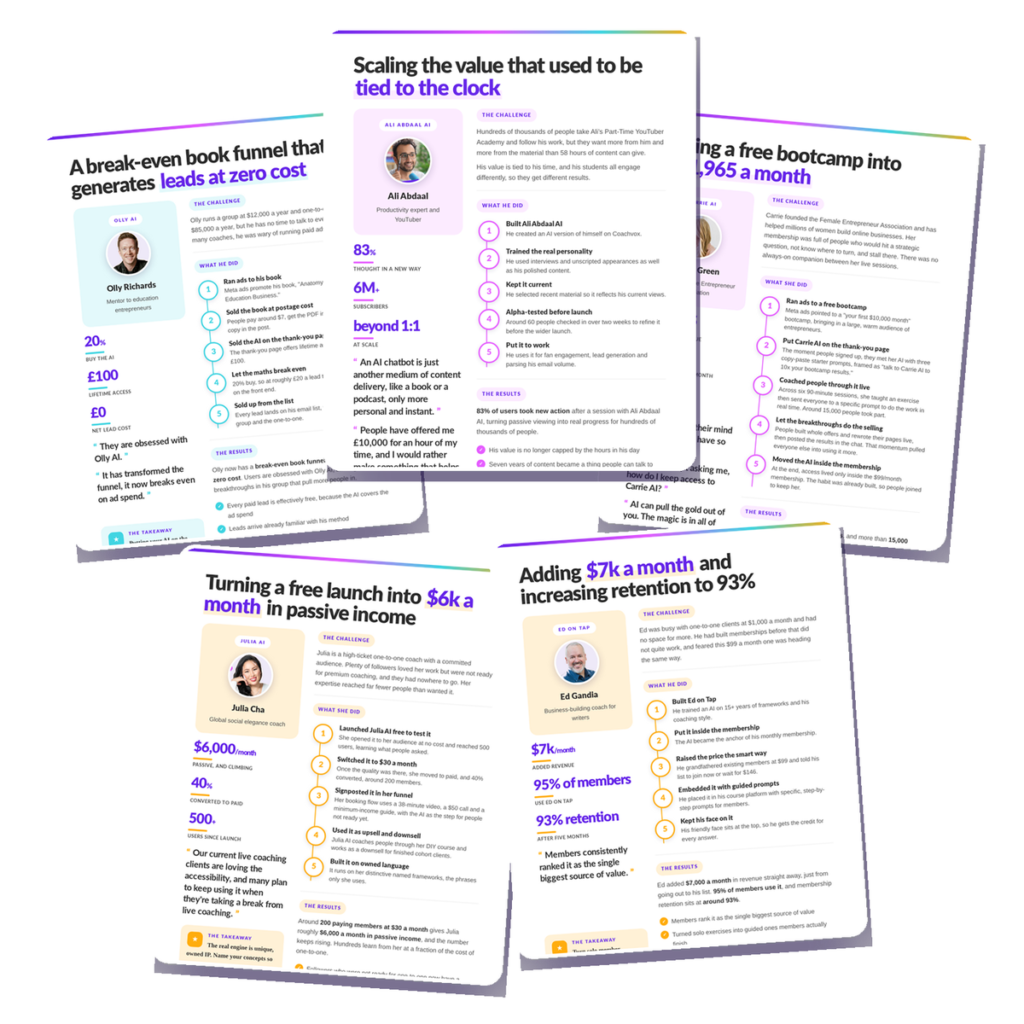
An AI version of you gives prospects a way to experience your thinking before they speak to you. They can ask a real question, test your approach, and get a feel for your method without booking a free call or sending you a long email.
This is perfect for building trust at scale because interaction creates a different level of confidence. Reading your website tells someone what you do. Asking your AI a question gives them a first-hand sense of how your ideas apply to their situation.
A strong digital asset builds trust by letting someone experience the value of your work before they invest at a higher level. That could be a free diagnostic, a $29 tripwire, or $500 course.
Free assets still build trust when they deliver on the promise. A good lead magnet can help someone make a clearer decision, understand their problem, or apply one part of your method. But paid assets do something extra: they prove that money spent with you creates value.
That’s key for coaches selling higher-ticket offers. If someone spends $29 and gets $300 of value, their risk calculation changes. If they spend $500 and get a life-changing result, they stop wondering whether your ideas are useful and start wondering what would happen if they worked with you more closely.
Accreditations, credentials, media features, podcast appearances, speaking gigs, books, awards, partnerships, and recognisable clients can all reduce perceived risk. They show that other people have trusted you, assessed you, invited you, or paid attention to your work.
Use the strongest markers where prospects already look: your homepage, sales pages, social profiles, lead magnets, email footer, and booking page. Do not hide the good stuff in a forgotten “about” page that only your mum and one unusually diligent prospect will ever read.
Credibility markers should support the bigger trust system around you. They give prospects another reason to feel safe taking the next step, especially when they are comparing you with coaches who make similar claims.
Coachvox lets prospects experience your thinking before they ever speak to you. Train an AI version of you on your content, methodology, and style, then use it as an interactive trust asset across your website, content, and digital products.
With Coachvox, you can:
Start you free trial today and get set up in minutes:
If people cannot find you, marketing deserves your attention. If people are finding you but not moving closer, trust is the layer to fix.
Start by looking at one part of your buyer journey: your content, website, proof, lead magnet, AI, tripwire, or discovery call process. Ask one question: does this give the right prospect more reason to trust me with their problem?
More traffic will not save a weak trust system. Build the proof, assets, and first experiences that make buying from you feel like the obvious next step.
Build trust at scale by making your expertise visible before people speak to you. Publish specific content, show your method, share detailed proof, create useful digital assets, and give prospects ways to experience your thinking without needing your personal time.
Trust at scale means building confidence with more people than you can personally speak to. Your content, testimonials, case studies, AI, lead magnets, digital products, and public reputation all help prospects trust you before they enquire.
Coaches build trust online by speaking directly to their ideal clients’ real problems. Generic advice gets ignored. Specific content, strong opinions, client proof, and visible methodology make the right people feel understood.
Yes, building your personal brand helps you build trust at scale because it makes your thinking more visible. When people repeatedly see your content, proof, opinions, method, and client results, they start forming trust before they ever speak to you.
Trust signals for coaches are the visible proof points that make a prospect feel safer taking the next step. These include testimonials, case studies, accreditations, media features, client results, digital products, useful content, and a clear coaching method.
You likely have a marketing problem if too few people find you. You likely have a trust problem if people find you, read your content, visit your website, or ask about working with you, then fail to move closer.
Content builds trust when it shows your judgement, standards, and understanding of your ideal client. Write about the problems your best clients bring to you, the mistakes you see, the decisions you help people make, and the beliefs you challenge in your work.
Yes, digital products can prove that spending money with you creates value. A free lead magnet can build confidence, but a paid tripwire, course, workshop, or implementation resource can show prospects that your ideas produce a return.
Coachvox helps coaches build trust at scale by creating an AI version of them trained on their content, method, and style. Prospects can ask questions, experience the coach’s thinking, and move closer before booking a call.
Yes, Coachvox can work as an interactive lead magnet for coaches. Instead of asking visitors to download another PDF, you can let them chat with your AI, explore your ideas, and understand how your coaching approach applies to their situation.
An AI version of you can build trust when it gives prospects a genuine experience of your thinking. It works best when it is trained on your real content, frameworks, client questions, and coaching style.
Build authority by publishing specific ideas consistently, not by posting constantly. A smaller body of sharp content, strong proof, useful assets, and clear methodology will do more for trust than daily posts that say very little.