A practical guide to using AI to generate leads, support clients, and scale your expertise
Your coaching business might be working perfectly well. Clients get results. Discovery calls convert. Your methods are solid. And yet somehow, every useful thing still seems to require you: your brain, your calendar, your replies, your follow-up, your ability to remember which Google Doc contains that brilliant framework from 2021.
That is where an AI-first coaching business makes sense. AI won’t take over the human work your clients actually pay you for, but it can handle a lot of the repeatable work around it: answering common questions, helping prospects experience your thinking, supporting clients between sessions, turning your content into useful assets, and keeping your business moving when you are not personally available.
This article will show you what AI-first means for coaches, why it matters, and how to build it into your business without making the whole thing feel cheap, generic, or weird.
An AI-first coaching business uses AI as an integral part of how the business runs, not as something you remember to use when you’re struggling with a LinkedIn post at 10 pm. It means AI has a proper role in how your expertise is shared, packaged, delivered, followed up on, and turned into value for clients and prospects.
That will not look the same for every coach. One AI-first coach might use AI to create a serious content engine. Another might use it to automate the parts of the business that usually eat up the afternoon. Another might give clients daily access to an AI version of their coaching style, so support does not disappear between sessions. In every version, AI becomes part of the business model. The coach’s judgement, standards, methodology, and relationships still set the quality of the work.

AI is not going to make coaching less valuable. The value will move towards coaches with a clear methodology, a strong point of view, and a business that can get their best thinking in front of more people.
A monthly call and a PDF worksheet used to feel like a solid coaching package. In some cases, it still is. But clients now have instant access to information, tools, prompts, summaries, templates, and AI support whenever they want it. They are getting used to having useful stuff available on demand.
That raises the standard for coaching businesses. A client may still want your insight and personal attention, but the rest of the experience needs to work harder. Workbooks, email support, community prompts, AI check-ins, personalised resources, and between-session guidance all make the coaching feel more complete. The one-to-one call can still be the centre of the work, but it should not be the only place value is created.
In an AI-heavy market, generic advice gets cheaper by the day. Anyone can ask ChatGPT for a confidence exercise or a set of questions for a difficult conversation. The coach with a recognisable method becomes easier to choose, because there is something specific to buy into.
That method needs to exist outside your head. AI can help you turn it into a book, a diagnostic, a client tool, a short course, a unique lead magnet, or an AI version of you. The format matters less than the ownership. If your best thinking has a name and a clear promise, people can understand it before they work with you. That makes it easier to trust, share, remember, and buy.
Prospects want to understand how you think before they trust you with a serious problem. That can happen through depth of content: articles, podcasts, videos, emails, case studies, and enough repeated exposure that your approach starts to feel familiar. The problem is that this takes scale, consistency, and time. Three good LinkedIn posts and a dusty podcast from 2022 will not do much heavy lifting.
AI-first coaches have more ways to create that familiarity. AI can help you produce more content from your existing IP, keep your nurture sequence alive, and turn your thinking into something prospects can interact with before they book a call. The content is still important. The difference is that AI helps more of it get created, repurposed, distributed, and experienced.
A coach who can serve more people has more room to build the business properly. More revenue means more options: better content, stronger ads, better production, stronger support, and more time spent on the work that moves the business forward.
AI-first coaches get scale on both sides of the business. They can serve at scale through stronger resources, better between-session support, smarter automation, digital products, and paid communities that do not depend on constant live delivery.
They can also market at scale through content systems, nurture sequences, repurposed IP, and lead magnets that keep working after the original work is done. That creates a flywheel: more ways to serve, more ways to sell, more money to build the brand.
As we’ve just seen, AI gives established names a way to serve people who would never have got access to them before. A famous coach can turn their back catalogue into something more useful than another free download: articles become nurture emails, books become practical tools, old videos become short-form content, and their methodology becomes easier to apply.
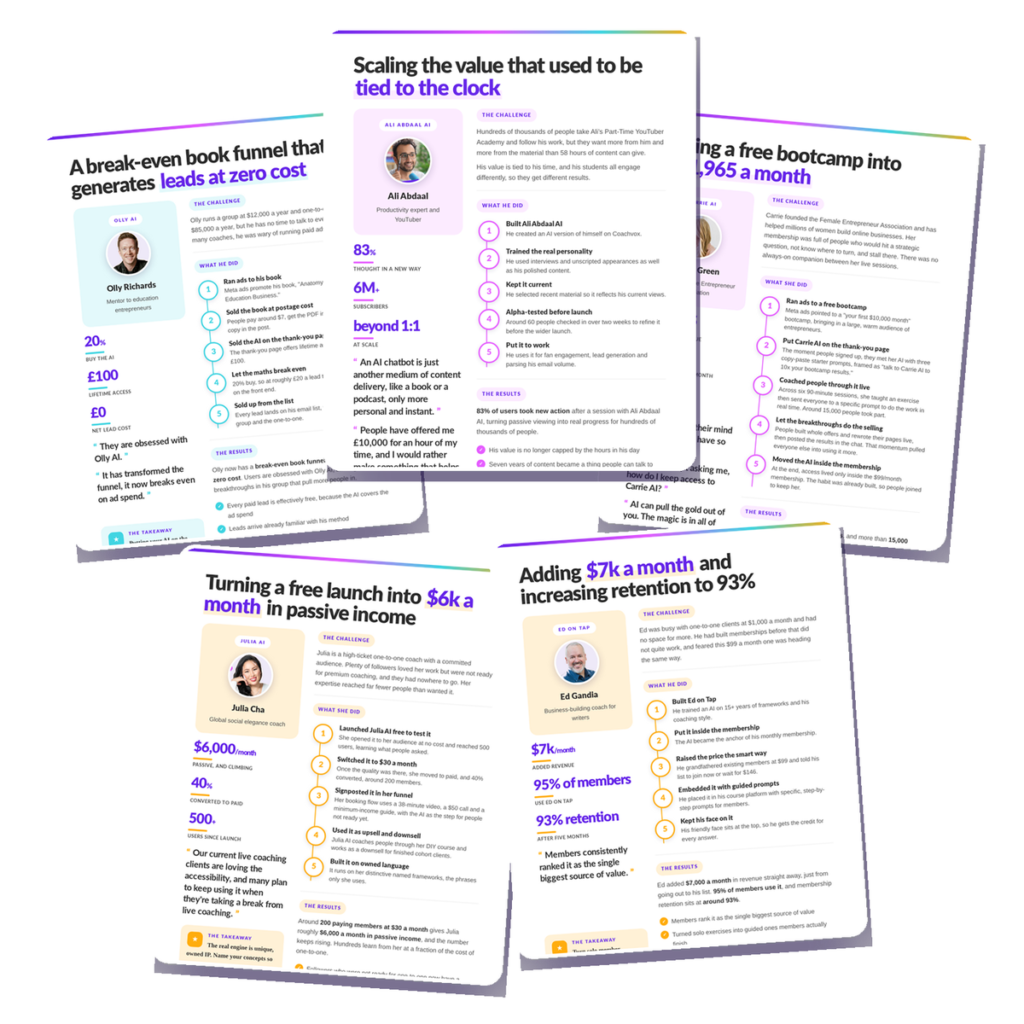
Ali Abdaal is a clear example. His audience already wanted his advice, but his time could not stretch to every person who wanted personal guidance. AI gave him another way to package and deliver his thinking at scale. If the best-known people in your space can make more of their work available, your own method and brand needs to be clear enough to stand apart.

Becoming AI-first is the obvious choice. You do not need a 15-tab spreadsheet, six new tools, and a weekend lost to YouTube tutorials. You need to decide where AI will make the business stronger, then build from there.
AI-first coaches do not need to wake up every morning and invent a new opinion for LinkedIn. That is how you end up staring at a blank document and wondering if this is strategy. Start with the ideas you already know land well: the post that got replies from good prospects, the framework clients mention back to you, or the podcast answer that should have been an article six months ago.
Once an idea performs, repurpose it properly. Use ChatGPT or Claude projects to turn the same thinking into posts, emails, articles, scripts, and newsletter sections without starting again every time. The writing still needs to sound like you. Set up clear brand voice guidance, feed in examples of your best work, and edit anything that sounds like it was written by a polite robot with a business degree.
Being visible on social media is useful. Owning an audience is better. A big following can disappear into an algorithmic void overnight, but an email list gives you a direct way to keep building trust with the people who have already shown interest.
Your lead magnet should earn that email address. It might be a diagnostic, a useful guide, a quiz, an AI version of you, or a short resource that helps someone make a decision. The job is to move the right people from passive attention into your world, then keep the relationship warm with newsletters and nurture sequences. If someone downloads the resource and never hears from you again, you have built a filing system, not a funnel.
Your content and lead magnet should be building a case in the prospect’s head before they ever book a call. By the time they reach your calendar, they should already understand your point of view, recognise the problem you solve, and have good reason to believe your approach fits.
AI can also make the calls themselves better. Record your discovery calls, transcribe them, and analyse what is actually happening. Look for the questions that get people talking, the moments where the call goes flat, and the objections that keep coming up. You do not need to become obsessed with call analysis. A quick review each week can show you what to improve, what to say more clearly, and where prospects are getting confused.
Clients do not stop needing support when the call ends at 11am on Tuesday. They hit the problem later, usually when they are busy, tired, or trying to apply what they learned in the real world. That is where between-session support becomes a serious part of the client experience.
An AI version of you can give clients access to your prompts, exercises, explanations, and coaching style between calls. It can remind them of the framework, ask a useful question, or point them back to the right resource inside your programme. An AI version of you helps clients stay closer to the work when you are not available. The human coaching still leads the process; the AI keeps the momentum going between cal
An AI-first coaching business should give people more ways to buy from you than a single high-ticket offer. Digital products, paid resources, and a membership can turn your IP into something people can use before they are ready for private coaching.
This also changes your positioning. When you have a clear product ecosystem around your method, your premium offer becomes easier to understand and easier to charge more for. A strong product ecosystem makes your premium offer easier to justify. The client can see there is a real method behind the work, with resources, tools, and direct access sitting around it.
An AI-first coaching business is connected. Your content should point to your lead magnet. Your lead magnet should feed your email list. Your nurture sequence should lead people towards the next useful step, whether that is a tripwire offer, a membership, or a discovery call.
This is where light automation earns its keep. A Coachvox can collect leads and pass them into your email system or CRM. Zapier can connect tools that would otherwise sit around ignoring each other. If you are more technical, Claude Code or similar tools can help build simple internal workflows. None of this needs to become a full-time engineering project. Start with the handoffs that are currently happening manually, then automate the boring ones first.
AI-first does not mean throwing every tool you find at the business and hoping one of them starts making money. That is how you end up with twelve logins, three half-built workflows, and no idea what any of them are supposed to do.
Start with the business problem, then choose the AI use case.
Do not sign up for a pile of AI tools because someone on LinkedIn made a dramatic carousel about them. Decide what needs improving first: lead capture, content, client support, onboarding, follow-up, or delivery.
Generic AI is fine for rough ideas and admin tasks. Your public-facing assets need more of you in them: your method, your examples, your language, and your standards.
Some parts of coaching should stay personal. Sensitive client issues, high-value decisions, and relationship-heavy moments need careful handling, not a workflow that fires because someone clicked the wrong tag.
More content will not fix a weak buying journey. If your posts do not lead people towards an email list, lead magnet, paid offer, membership, or discovery call, you have activity rather than a system.
A clever AI tool is only useful if it connects to the business. It should capture leads, support clients, improve delivery, create insight, or move someone towards the next step.
Test the tone, accuracy, boundaries, and client experience before you put anything in front of prospects or paying clients. Your AI-first business still has your name on it.
Get your AI coach working as part of your AI-first business
Coachvox already fits into a lot of what we’ve covered here. It gives you an AI version of you that can act as a lead magnet, support clients between sessions, answer common questions, and help more people experience your coaching style before they book a call.
Top coaches use Coachvox to turn their methodology into something prospects and clients can actually interact with.
Start your free trial today. Set up takes less than an hour.
An AI-first coaching business does not need to be complicated. Start with the part of the business that already has value but still depends too much on you: the content you keep meaning to repurpose, the lead magnet that should be doing more, the client questions you answer every week, or the premium offer that needs a stronger ecosystem around it.
The coaches who do well from here will be the ones who make their best thinking easier to find and easier to experience before someone buys. AI gives you a way to do that without turning yourself into a full-time content machine. Your expertise is already the asset. The next job is getting it working harder.
An AI-first coaching business uses AI as an integral part of how the business runs. AI supports the coach’s marketing, lead generation, content, client support, delivery, follow-up, and scalable offers. The coach’s methodology still sets the standard.
An AI-first coach uses AI to make their expertise easier to access, experience, and buy. That might mean using AI for content creation, an AI lead magnet, between-session support, digital products, internal workflows, or a paid AI-powered offer.
Coaches can use AI to create better content, build useful lead magnets, answer prospect questions, and keep email nurture sequences moving. The strongest lead generation use cases give prospects a first experience of the coach’s thinking before they book a call.
Coachvox lets coaches create an AI version of themselves trained on their content, methodology, and coaching style. It can act as an AI lead magnet, support clients between sessions, collect leads, answer common questions, and give prospects a more useful first step before a discovery call.
AI-led coaching usually means a client receives coaching-style support from an AI system. In a coaching business, this works best when the AI is trained on a specific methodology and has clear boundaries. It should support the wider coaching experience rather than pretend to be a human coach.
AI can give clients access to prompts, exercises, reminders, explanations, and next-step guidance between calls. This keeps clients closer to the work when the coach is not available. Coachvox is built for this kind of between-session support because the AI can be trained on the coach’s own material.
Start with the material that best represents your work: frameworks, articles, books, client resources, FAQs, workshop notes, podcast transcripts, and answers to common client questions. Clean material creates better output. With Coachvox, you can simply drag and drop your files to train the AI.
Yes. AI can help coaches turn their IP into guides, courses, diagnostics, workbooks, paid resources, and supporting content. The coach still needs to decide the promise, structure, and standard of the product. AI speeds up the production work once the thinking is clear.
Yes, some coaches charge for access to their AI as a subscription, membership benefit, or lower-cost offer. This works best when the AI gives genuine value from the coach’s own methodology. Charging for a generic chatbot with your name on it is a hard sell, and rightly so.
Pick one part of the business where AI can create a clear improvement. Content, lead generation, between-session support, and follow-up are good places to start. Choose the use case that connects most directly to revenue, client experience, or time saved.
Give the AI clear examples of your best writing, your brand voice, and the phrases you would never use. Then edit the output like a draft, not a finished piece. AI can speed up content creation, but your taste is what stops it sounding like everyone else.