Build demand for your expertise, give clients more value and grow beyond your calendar.
You’ve built a coaching business that gets results. You have experience, client relationships and ideas worth sharing. Now you want more people to know your work, more enquiries from clients you’d love to help, and more income without adding another ten hours to your week. Choosing where to put your effort is the next business decision.
The coaching business growth strategies worth pursuing in 2027 will make better use of what you’ve already built. A stronger personal brand, a useful digital asset or a better buying experience will each serve a different purpose. This guide will help you choose the right priorities for your business and turn them into a practical growth plan.
Where prospects find you, why they choose you and what keeps them engaged should shape your growth decisions. These three considerations explain where to focus.
A recommendation gives someone your name. Your online presence gives them reasons to take it further. A prospective client visiting your website or LinkedIn profile should find useful thinking, relevant results and a clear explanation of how you help. Every unanswered question creates more work for the sales conversation, assuming they book one.
Making your expertise easier to find gives more suitable buyers a route to your business. That includes people researching a problem who haven’t heard of you yet. An article that answers their question or a guest appearance on a podcast they trust introduces your work before they’ve decided to hire a coach.
The 2025 ICF Global Coaching Study estimated 122,974 coach practitioners worldwide. That’s probably a fraction of everyone charging for something they call “coaching”. Buyers have no shortage of people offering to solve their problems. Being known for a valuable result gives them a reason to remember you and seek out your approach.
A recognised personal brand makes each introduction more valuable. Prospects arrive familiar with your thinking, referrals come with a clearer explanation of your work, and invitations reach you because someone associates your name with the subject. That recognition supports future launches as well as the offer you’re selling now.
Your clients want to apply what they’re learning. Someone working through your course or membership who gets stuck wants guidance while the problem is in front of them. Searching through forty recordings for an answer takes time they intended to spend making progress.
Personalised guidance on demand adds value to the engagement. Relevant resources and an AI trained on your methods give clients a way to work through questions when they arise. Making your approach easier to apply strengthens the experience they’re paying for and gives them a reason to keep working with you.

Each strategy below serves a different business goal. Choose according to where you want growth to come from and what you’re prepared to build.
A strong personal brand gives people a clear association between your name and the work you do. When someone needs help with the problem you solve, you want to be the coach they think of, recommend or invite to speak. That recognition creates opportunities well beyond your next social media post.
Choose the expertise you want to be known for and demonstrate it repeatedly. Share your perspective on problems your clients face, explain decisions through your methodology and show credible examples of progress. Give people enough exposure to recognise your thinking. Changing your message every fortnight makes that unnecessarily difficult.
Invest here if your clients rate your work highly but recognition outside your existing circle is limited. Begin with a subject you have the experience and evidence to speak about with authority. Our guide to becoming an in-demand coach explains how to build that recognition into demand for your work.
Your growth plan needs a deliberate way to reach more suitable buyers. Pick a primary channel based on where your ideal clients spend time and how they research help. A leadership coach selling to company founders needs a different distribution plan from a relationship coach selling directly to individuals.
Use opportunities that put your expertise in front of an established, relevant audience. Guest teaching inside a business community, appearing on a specialist podcast or running a workshop with a trusted partner gives people a reason to pay attention. Check who the audience includes before committing. A room full of other coaches is useful only if other coaches buy your services.
Give interested people a way to stay connected through your email list. Use your emails to develop ideas, answer buying questions and invite a relevant next step. Track qualified enquiries from each source so you know where your effort produces business. Our guide to consistent deal flow covers building those routes into a repeatable acquisition process.
Your existing work contains material that prospects will find useful before they hire you. Turn a recurring client problem into a resource that helps someone understand their situation or make a decision. An assessment, practical guide or interactive AI experience gives them a direct introduction to your approach.
Choose the problem before choosing the format. A coach helping founders delegate could create an assessment that identifies which decisions still depend on them. The result should give the founder something useful to act on and explain where further support fits. That creates a natural connection between the resource and the paid offer.
Build one asset around a question your best prospects already ask. Promote it through your chosen channels and use follow-up emails to help people apply it. Measure the enquiries it generates and whether those people match your ideal clients. Downloads alone won’t tell you whether the asset deserves more investment.
Someone interested in your work should understand what you offer and how to take the next step. Your discovery-call page needs to explain who the call is for, what you’ll discuss and what happens afterwards. Include relevant client proof and answer the questions that would otherwise delay a booking.
Make the process straightforward on a phone. Check the page, booking form and confirmation yourself. Remove questions that serve no useful purpose, make time zones clear and explain any preparation required. Asking someone to complete a small autobiography before a first conversation gives them plenty of time to reconsider.
Match the buying process to the offer. A substantial coaching engagement deserves a conversation; a clearly explained digital product should be straightforward to purchase. Invest here when your content and referrals already generate interest, because improving the next step makes better use of the attention you’ve earned. Our guide to getting more discovery calls booked covers the booking process in more detail.
A more useful client experience makes your offer easier to sell and gives clients stronger reasons to renew. When prospects see how you’ll help them apply your expertise, get personalised guidance and make progress between live interactions, the value of the engagement becomes clearer. You have more to sell than access to your calendar or a collection of recordings.
Build support around the moments when clients need help. A course participant wants to adapt your framework to their business. A membership subscriber needs guidance before the next group call. An AI trained on your methods gives them answers on demand, helping them keep moving and get more from the work they’ve paid for.
Prioritise this investment if your renewal rate is lower than you’d like or prospects need too much convincing about what’s included. Support that helps clients achieve their goals strengthens your pitch and improves retention, increasing the revenue you earn from each relationship. Our article on AI client support explains how to deliver that guidance through your own methodology.
An additional paid offer gives people another way to work with you and increases what your business earns beyond individual calls. Choose the model according to the help clients need. A group programme suits people working towards a shared outcome. A membership needs an ongoing reason to stay. A digital product suits a defined problem that people can work through with less personal input.
Validate demand before building the full offer. Invite suitable prospects or existing clients into a small paid pilot with a clear result and delivery plan. Their willingness to pay, questions and experience will tell you more than spending three months recording lessons for an untested course.
Account for the work involved after the sale. A low-priced membership that requires constant personal replies will consume the capacity you intended to create. Compare revenue with delivery time and support costs, then refine the model before expanding it. Our guide to scalable coaching offers explores the options and their practical requirements.
Growth needs time you can leverage. Identify recurring work that takes attention away from your chosen strategy, then improve one process. Booking reminders, routine onboarding emails and preparing content from your existing material are sensible places to begin.
Keep your judgement where the quality depends on it. AI can prepare a post from a workshop transcript; you check the argument, examples and voice before publishing. An automated welcome sequence can deliver the right resources; you decide what clients need and in what order. Review the output before relying on the process.
Use the hours you recover for a growth activity. Put the workshop outreach or digital asset development into your calendar. Track the time saved after checking and maintenance, so you know whether the change has created useful capacity.
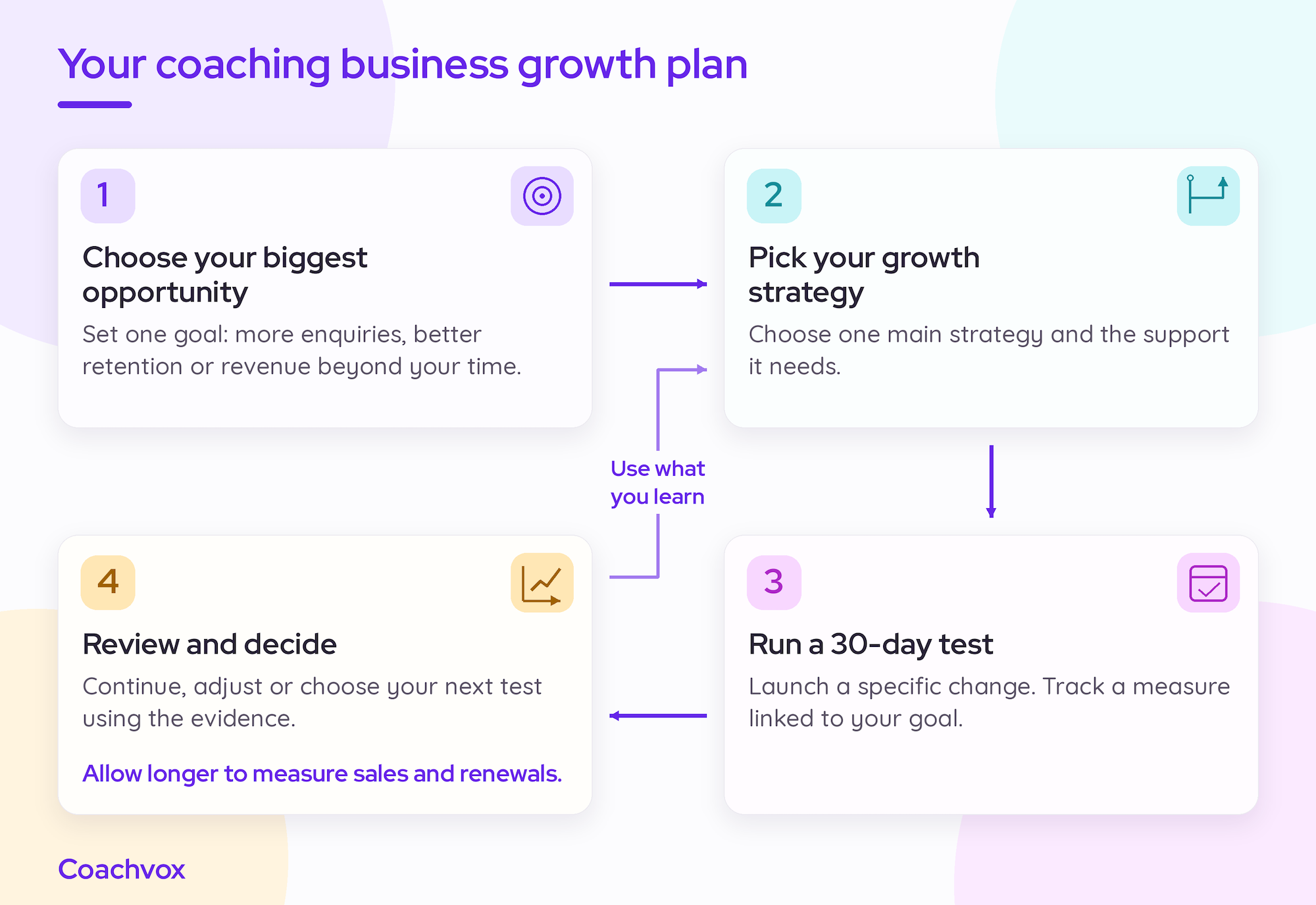
Turn your chosen strategies into a plan you’ll actually follow. Give each change a clear purpose, a deadline and a way to judge the result.
Decide what you want growth to look like. More qualified enquiries, stronger renewal rates and revenue beyond individual appointments each require different work. Choose the outcome that would make the biggest difference to your business over the coming year.
Use what you already know about your enquiries, sales and client relationships to set that priority. If you’re unsure where progress is being held back, our guide to why your coaching business isn’t growing will help you identify what deserves attention first.
Choose a main strategy that serves your goal, then identify what it needs to work. If you want more inbound enquiries, build your personal brand and give interested people a useful digital asset. If you want better retention, improve client support and make that support part of onboarding.
Work with the strengths and resources you already have. An engaged email list gives you somewhere to test an offer. A collection of workshop recordings gives you material for a digital asset. Set aside time for the work and decide whether outside expertise would speed it up. Spending money is optional; making time is essential.
Define a change you can launch and assess within 30 days. Rewrite your discovery-call page, promote an assessment or introduce personalised guidance to a group of existing clients. Name the person responsible and set a launch date that leaves time to gather feedback.
Choose a measure linked to the intended outcome. For a booking page, track completed bookings against relevant visits. For a new client resource, track use and whether it helps people resolve their questions. Record the current position before making the change so you have something to compare.
At the end of 30 days, decide what deserves more effort. Look at the response from suitable prospects or clients, the work involved and the progress towards your goal. A few useful conversations will tell you more than a week of disappointing LinkedIn impressions.
Allow longer when the result depends on a buying or renewal cycle. Early engagement gives you an indication within 30 days; completed sales or renewals need a later check. Keep a review date in the calendar, record what you’ve learned and use it to choose the next test.
Coachvox turns your content, methods and communication style into an AI version of you. Use it across your growth strategy, from introducing prospects to your expertise to giving paying clients personalised guidance on demand.
Show what makes your approach different: let people experience your thinking through a conversation.
Build trust before the sales call: give prospects useful answers that demonstrate your expertise.
Capture leads around the clock: collect contact details from people engaging with your AI.
Add value to existing offers: include personalised AI support in your coaching packages, courses or memberships.
Create another paid offer: charge for access to your AI.
Create content in your voice: turn your expertise into material that builds recognition for your work.
Give it a try today:
You already have expertise, client relationships and work worth sharing. Your next stage of growth depends on how you put them to use. Choose the strategy that serves your biggest opportunity and commit time to testing it.
Write down what you’ll change, when you’ll launch it and how you’ll judge the response. Review the evidence after 30 days, then decide what deserves more effort. A year gives you room to test, improve and build on what works. Give your first test a launch date.
Prioritise the strategy that serves your biggest commercial opportunity. If you want more qualified enquiries, invest in recognition and reaching suitable buyers. If demand is healthy and your calendar is full, test an offer that serves more people. Choose one main outcome so your time goes towards a clear business goal.
Set your growth budget around a specific test and what the result is worth to your business. Improving website copy, contacting potential partners and promoting an existing resource mainly require time. Pay for expertise or tools when they remove a clear obstacle. Set a spending limit before testing paid promotion, then assess the cost of acquiring a suitable client.
Yes. A small audience of suitable buyers is enough to support a coaching business with a limited number of premium places. Make your expertise and client results easy to assess, and give interested people a clear next step. Judge audience quality through relevant enquiries and sales conversations, alongside the number of people you reach.
Create an asset that answers a recurring prospect question and connects to your paid offer. An assessment suits someone who needs to understand their situation; a guide suits a defined task. An AI version of you built with Coachvox gives prospects personalised interaction with your methods. Choose the format according to the experience the buyer needs.
Grow revenue through an offer that serves several people together or gives paid access to your expertise on demand. Group programmes, memberships and digital products each have different delivery requirements. Test one with paying customers, then compare the revenue with the support time and costs involved. Our guide to digital products for coaches explains how these offers fit together.
Use 30 days as your first review point, with a measure matched to the change you made. A revised booking page needs relevant visits; a new client resource needs people using it. Allow 60 days or longer to assess sales or renewals when the buying cycle requires it. Limited exposure means you need more evidence before reaching a conclusion.
Coachvox turns your expertise into an interactive AI asset for prospect engagement, lead capture or paid client support. Give it one clear role in your growth plan first. For example, introduce it through your newsletter and measure relevant conversations and enquiries. Expand its role once you understand how your audience uses it.
Yes. Coachvox gives course participants and membership subscribers personalised guidance based on your content and methods. They ask questions when applying the work and receive support on demand. Include that access in your offer and onboarding, then track usage, client feedback and renewals to assess its contribution to the experience.