
Your guide to leveraging AI (and not being replaced by it)
AI tools can now write workout plans, answer business questions, and deliver mindset coaching at scale. Some coaching niches will feel the pressure sooner than others. Your safety depends on what you coach and how you deliver it, plus what makes you different from both AI and other human coaches.
Remote coaches using templates face the biggest threat. In-person coaches with professional credentials face the smallest. Most coaches sit somewhere in between. Your niche determines your baseline exposure. Your personal traits move you up or down from there.
Of course, AI represents a huge opportunity for smart coaches to transform their business for the better. This article examines risk across two scales: your coaching niche and your individual differentiators. Then we look at how to set yourself for success with AI.
Your coaching niche determines your baseline risk before individual factors come into play. AI handles remote, templated work better than embodied, regulated, or trust-critical services. The nature of your work and how you deliver it create the first layer of protection or vulnerability.
AI coaches trained on your methodology can extend your reach, but they cannot replace work that requires professional licensure or legal accountability. Here are some types of coaches and their risk from AI.
Psychotherapists, clinical counselors, and licensed mental health professionals work behind regulatory walls that AI cannot cross. Your license, professional indemnity, and duty of care create legal accountability no software can assume. This protection holds only for your regulated scope of work.
Your clients need more than good advice. They need a qualified professional who carries legal responsibility for their wellbeing. AI cannot diagnose conditions, hold liability, or provide the protected relationship therapy demands. You might use an AI coach for psychoeducation or support between sessions, but it cannot deliver therapeutic services. Professional bodies make this boundary enforceable by law, not just preference.
AI augmentation can extend your reach between sessions and after program completion. Clients get ongoing support while you serve more people without compromising care quality.
You watch form break down in real time and correct it before injury happens. Your hands adjust posture, your voice cues timing, and your eyes catch compensation patterns clients don’t feel yet. AI can write workout programs, but it cannot spot a hip shift during a squat or feel tension in someone’s shoulder.
Higher level coaching demands even more. Elite athletes need split-second feedback during complex movements, periodization adjusted to how their body responds week to week, and motivation calibrated to their mental state that day. An AI coach might handle programming, nutrition planning, and track metrics between sessions, but the physical presence and real-time assessment remain irreplaceable. Your ability to read someone’s body and adapt on the spot keeps you protected.
Risk: Those trainers taking clients through the motions aren’t immune. If all they’re looking for is some guidance and accountability to stay healthy, AI coaches are coming.
You work with decisions that shape companies and careers. Your clients trust you with confidential strategy, team conflicts, and personal doubts they cannot share elsewhere. Board-level leaders need someone who understands power dynamics, reads between the lines, and challenges their thinking without corporate risk.
AI cannot replicate the judgment required here. These coaching relationships depend on discretion, lived experience at senior levels, and the ability to probe without breaking trust. You might use AI tools for research, preparation, or frameworks, but the high-stakes conversations happen human to human. Executives pay for wisdom and confidentiality, not templates.
Risk: Junior managers seeking frameworks and accountability are a different story. AI coaches can deliver proven leadership models at scale for a fraction of your rates.
You guide people through the messiest parts of being human. Your clients bring betrayal, desire, shame, and vulnerability that demands nuanced judgment. Relationships resist formulas because every dynamic carries its own history, attachment patterns, and unspoken needs.
AI can suggest communication techniques or explain attachment theory. It cannot read the room when a couple sits in loaded silence, sense when someone is hiding something, or know when to push versus when to hold space. Your work depends on emotional intelligence and lived experience that algorithms cannot replicate. Clients pay for your ability to see what they cannot say.
Risk: Basic relationship advice is everywhere online for free. If your coaching stops at generic tips about boundaries or love languages, AI tools will handle that work cheaper and faster.

Your work resists standardization by design. Energy work, intuitive guidance, ancestral practices, and spiritual lineage cannot be reduced to prompts and templates. Clients seek you for belief systems and embodied wisdom that exist outside mainstream frameworks.
AI struggles with anything that depends on personal transmission, ritual, or non-rational knowing. Your credibility comes from your practice, your teachers, and your own transformation. These elements create natural barriers to automation that protect your niche.
Risk: Discovery presents your bigger challenge. Potential clients searching online may never find you if AI surfaces generic spiritual advice first. Your protection comes from community, word of mouth, and clients who specifically want human guidance on their path.
Meal plans and macro calculations are prime AI territory. Generic nutrition advice based on goals, dietary preferences, and calorie targets can be automated completely. ChatGPT already generates weekly meal plans in seconds, and specialized nutrition AI tools are improving fast.
Your protection comes from complexity and personalization. Managing client expectations and motivation, blood work interpretation, assessing conditions that require medical knowledge, and ongoing adaptation based on how someone’s body responds create defensibility. Registered dietitians with clinical skills sit safer than coaches offering template plans.
Risk: If your service is meal planning with occasional check-ins, you’re competing directly with free AI tools. Clients want convenience and cost savings, and AI delivers both without the scheduling friction of human coaches.
Generic business coaching is AI’s sweet spot. Goal setting, productivity frameworks, mindset work, and accountability can all be delivered through conversational AI trained on thousands of business books and podcasts. Your clients can get similar advice from ChatGPT for free or from an AI coach for a monthly subscription.
Sector-specific expertise changes the equation. A business coach who spent a decade in SaaS sales, worked with 50 software founders, and knows the exact challenges of scaling from 10 to 30 employees brings irreplaceable context. AI cannot replicate the experience from repeatedly solving the problems in the field.
Risk: If your coaching relies on asking powerful questions and applying generic business models, AI can do that at scale. Clients increasingly question why they should pay your rates when AI gives them instant access to proven frameworks.
Broad life coaching with no clear specialization faces the steepest AI threat. Goal clarification, limiting belief work, accountability, and motivational support are exactly what conversational AI handles well. Your potential clients already use ChatGPT or a Coachvox for these conversations daily.
Remote delivery makes this worse. You meet on Zoom, ask reflective questions, and send follow-up emails between sessions. AI coaches replicate this entire workflow while being available 24/7 at a fraction of the cost. Clients get instant responses instead of waiting for your calendar to open.
The market is splitting. Coaches with proven methods, strong personal brands, and specific client outcomes can still command premium rates. If you’re living the dream, people will pay to know how. Everyone else competes with free AI that improves every month and never gets tired of hearing the same problems.
De-risk your coaching business from AI
Offer 24/7 access to your AI version to stop clients using someone else’s AI. Top coaches use Coachvox to create an AI version of themselves, giving clients access to their brain around the clock.
Two coaches in the same niche face different levels of threat based on what they bring beyond their specialty. Your credentials, track record, methods, and visibility create layers of protection that separate you from both AI and other human coaches. These differentiators determine whether clients choose you, a competitor, or a free AI tool.
Credentials create immediate trust that AI cannot claim. Your ICF accreditation, specialist certifications, or professional memberships signal competence before you say a word. Clients compare options and see your qualifications as proof you know what you’re doing.
Ongoing professional development matters too. Annual training requirements, ethics compliance, and supervised practice hours demonstrate you’re staying current. These elements build confidence that you’re operating at a professional standard, not just winging it based on personal experience.
Clients shopping for coaches filter by credentials first. They want someone qualified, not just enthusiastic. Your certifications move you into a different consideration set than uncredentialed coaches or AI tools that cannot hold professional standards.
You’ve built 30 businesses or coached 100 clients through the same transformation. That lived experience creates real-world pattern recognition AI cannot match. Clients trust someone who has done the work over someone who studied it or an algorithm trained on theory.
Quantified outcomes change the conversation. Revenue increases, time saved, teams grown, or problems solved give prospects concrete proof your coaching delivers. Case studies showing real client journeys with measurable results make price objections disappear. Rather than selling advice, you’re selling outcomes you’ve already produced multiple times.
Generic coaching experience means little. If you cannot point to specific, repeatable results with numbers attached, you’re competing on price with tools that cost nothing.
Your signature system sets you apart from both AI and other coaches. A documented method with your name on it creates intellectual property that raises your perceived value. Clients want proven processes, not ad hoc conversations that might lead somewhere useful.
Your framework needs genuine distinctiveness. Repackaging common knowledge with a new acronym fools nobody. The method should solve a specific problem in a way clients can understand and remember. When prospects hear about your system from multiple sources, it becomes the reason they choose you. With a Coachvox, you’re even able to give your audience a taste of your work without wasting time on introduction calls.
Coaches without named methods compete on personality and price. AI delivers frameworks from thousands of experts instantly, making your lack of unique IP a liability.
Your name shows up when prospects search. You’ve published articles, spoken at events, appeared on podcasts, or written a book. These visibility markers create preference for you specifically rather than generic solutions or cheaper alternatives.
Thought leadership positions you as the expert clients want. Regular content demonstrating your expertise, media features adding third-party credibility, and speaking engagements proving others value your knowledge all compound into authority. Prospects arrive already convinced you’re worth the investment.
Low visibility means you’re starting from zero with every prospect. If nobody has heard of you, why would they pay premium rates instead of trying ChatGPT or another coach’s AI first?
Word of mouth from satisfied clients beats any marketing you could create. When someone’s trusted colleague or friend recommends you, the sale is half done. Referrals come pre-sold on your value because they’ve seen real results in someone they know.
Testimonials and case studies provide social proof at scale. Prospects need to see that real people paid you money and got meaningful results. Video testimonials carry even more weight because they’re harder to fake. The more specific the outcomes and the more credible the source, the faster prospects convert.
Coaches without strong social proof face constant skepticism. Prospects wonder if you’re any good or just another person with a website and a calendar link.
You have no recognized credentials, limited proof of outcomes, no distinctive method, and minimal online presence. Nothing separates you from thousands of other coaches making similar claims. Prospects see you as interchangeable with cheaper or free alternatives.
Your positioning is broad and vague. You help people “reach their potential” or “achieve their goals” without defining who, what, or how. This generic messaging makes you invisible in a crowded market. AI can deliver the same level of specificity for free.
Commodity coaches compete purely on price and availability. When you offer nothing distinctive, clients have no reason to choose you over AI that costs less and responds instantly. Your business depends on prospects who haven’t discovered free alternatives yet.
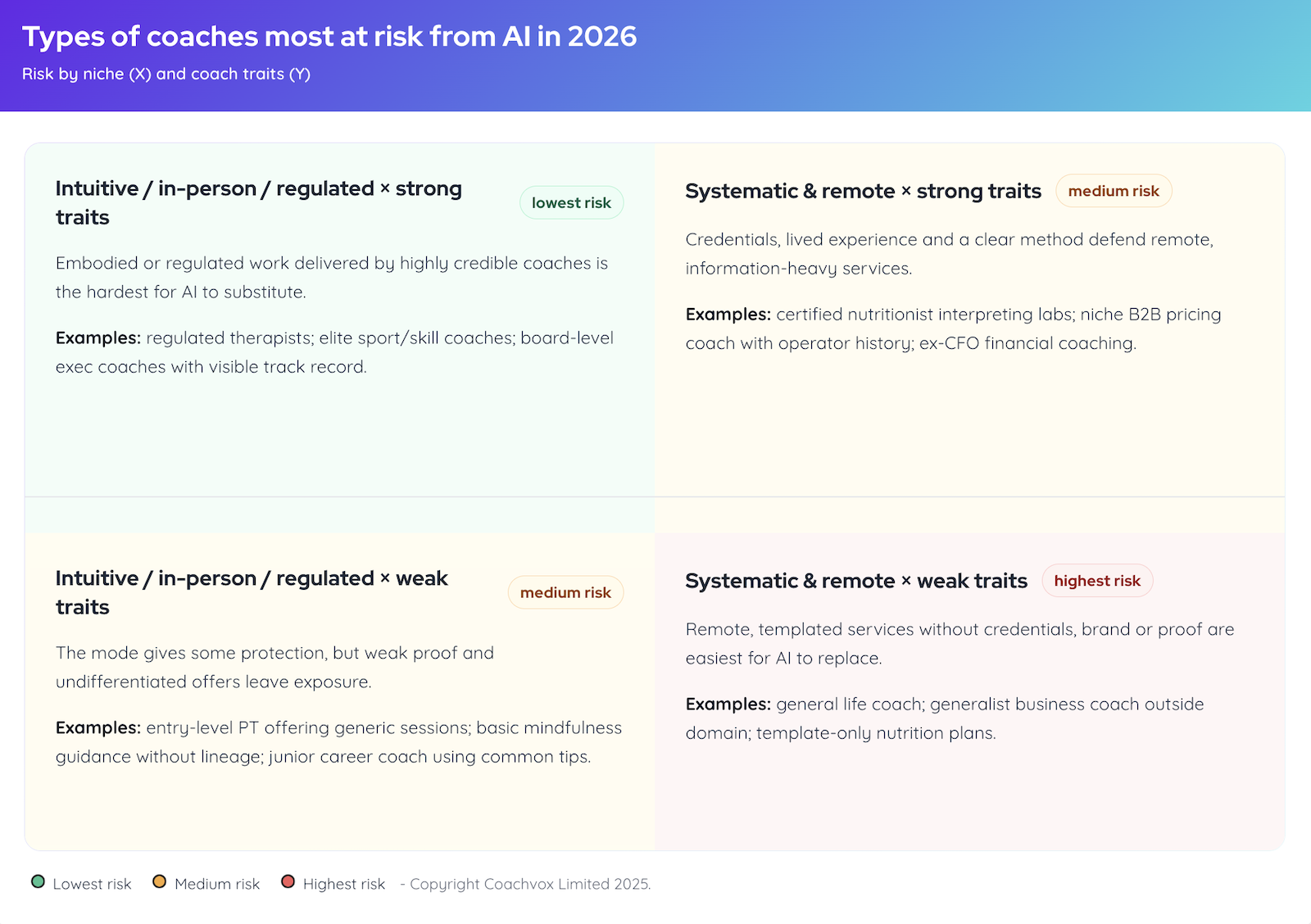
Let’s put these factors together and see the full picture of which coaches are facing the biggest risk from AI in the near future:
Risk by niche (X) and coach traits (Y)
Embodied or regulated work delivered by highly credible coaches is the hardest for AI to substitute.
Examples: regulated therapists; elite sport/skill coaches; board-level exec coaches with visible track record.
Credentials, lived experience and a clear method defend remote, information-heavy services.
Examples: certified nutritionist interpreting labs; niche B2B pricing coach with operator history; ex-CFO financial coaching.
The mode gives some protection, but weak proof and undifferentiated offers leave exposure.
Examples: entry-level PT offering generic sessions; basic mindfulness guidance without lineage; junior career coach using common tips.
Remote, templated services without credentials, brand or proof are easiest for AI to replace.
Examples: general life coach; generalist business coach outside domain; template-only nutrition plans.
You cannot change your niche overnight, but you can strengthen your differentiators starting today. These five moves reduce your AI exposure by making you harder to replace and easier to choose. Pick one, implement it properly, then move to the next.
Generic positioning makes you comparable to AI. or more well-know coaches Specific positioning makes you the obvious choice for a defined group. Write an outcome statement that names who you serve, what problem you solve, and what result they get. “I help SaaS founders go from reactive firefighting to predictable growth in 90 days” beats “I help entrepreneurs succeed.”
Collect three to five case studies with before and after metrics. Revenue increases, time saved, or quantified improvements give prospects confidence you can replicate results. Cut services that dilute your focus. Make one flagship offer that solves one expensive problem. Your conversion rate and average price should rise while unqualified inquiries drop.
Recognized qualifications reduce buyer hesitation. Choose one credential that builds trust in your market. ICF accreditation for leadership coaches, registered dietitian status for nutrition work, or sport-specific certifications all change how prospects evaluate you.
Build proof that changes decisions. Quantified case studies, testimonials with numbers, and before-after evidence create confidence AI cannot provide. Run a small group with clear baseline and post-program metrics, then request detailed testimonials. Your sales cycle should shorten and win rate should climb.
Name your method something memorable and map it into four to six clear steps. Create worksheets, checklists, and tools that demonstrate your approach. Your signature framework transforms experience into defensible property that clients pay more for.
Document your top ten repeat answers as procedures and turn three into client-facing tools. Build a diagnostic, a playbook, and a red flags guide that require human judgment. Your delivery time should drop while perceived uniqueness rises. Referrals should mention your framework by name.
Build IP and a brand to be reckoned with
If you’re serious about scaling your coaching business in the age of AI, join top coaches learning how on Coachvox Academy.
Prospects who already know your work convert faster and question price less. Post two substantial pieces weekly showing real outcomes and your thinking. Add one speaking engagement quarterly. Case studies with numbers and contrarian insights outperform generic tips.
Speaking appearances, podcast features, and client logos create validation AI cannot match. Write posts with screenshots, numbers, and lessons from real work. Update your about page to highlight operator experience. Your inbound inquiry percentage should grow and branded search volume should climb.
Let AI handle research, summaries, and draft creation so you focus on diagnosis and judgment. Use it to draft research briefs, synthesize notes, and create first-pass plans. You add context and make calls that require human experience.
Deploy AI tools like Coachvox for client support. Your AI coach handles common questions, provides a sounding board for clients, and helps you create marketing material, while you focus on live sessions.
Clients get faster responses while you spend time on high-value work. Standardize three core prompts for research, synthesis, and documentation. Your prep time should drop 30 to 50 percent while satisfaction stays steady. Never let AI set strategy. Always add your reasoning and context it cannot see.
It’s time to take AI seriously and de-risk the threat to your coaching business.
Coachvox is the tool of choice for top coaches seeking to capture leads, add more value to clients, and scale their impact.
Try Coachvox today for free to see how AI can take your business to the next level:
Look at your current coaching practice through two questions. Can your work be delivered remotely using templates and frameworks? Do you have weak credentials, limited proof, no named method, and low visibility? If you answered yes to both, you’re in the highest risk zone. Moving to safety means strengthening at least one dimension.
If your niche exposes you because the work is remote and systematic, build stronger differentiators through credentials, proof, IP, and brand. If your traits are weak but your niche offers some protection, sharpen those traits before someone else does. Pick one move from the playbook and execute it well. The coaches thriving in 2026 will be those who made themselves irreplaceable on at least one scale.
You’re high risk if your offer is remote, template-driven, and hard to tell apart from generic advice. Look for these signals: prospects ask for “a plan” not judgement; buyers compare you on price; outcomes aren’t quantified.
Narrow the problem you solve and publish three data-backed case studies. Next: name your method, tidy your onboarding, and add one credible credential or CPD that buyers recognise.
Specialising usually increases qualified leads even if raw volume dips. It raises conversion, pricing power, and referrals because buyers see “for people like me” proof.
Credentials that grant scope, compliance, or recognised standards change decisions. Pick ones your buyers already trust (e.g., ICF/EMCC, regulated dietetics, sport-specific accreditations).
Aim for 5+ concise case studies with before→after metrics. Use consistent fields (baseline, intervention, result, timeframe) so buyers, search engines, and LLMs can “read” them quickly.
Give your process a name and a 4–6 step map with inputs, actions, and success criteria. Add one diagnostic, one checklist, and one “red flags” guide clients can’t self-serve with AI.
Use AI for research, note-taking, synthesis, and first drafts, keep diagnosis and prioritisation human. Use a Coachvox to provide support between sessions or as part of your marketing and lead generation activity. Be transparent about when and why you use AI in your business.
Yes, use it to pre-qualify leads, answer FAQs, and book calls while you focus on high-trust work. With Coachvox, your AI “clone” stays on-brand, builds familiarity with your audience and plugs straight into your CRM.
Use Coachvox to deliver instant, on-brand answers, generate new leads, and help you create content in minutes, not hours. It scales the “busywork” and keeps you front-and-centre for judgement, rapport, and accountability.
In 8–12 weeks you can niche, publish proof, and standardise your method. Credentials and brand assets compound over 3–6 months; plan for visible lifts in win rate and pricing.
Letting AI produce the plan or advice without your review is the quickest way to lose trust.
Use AI ethically and confirm client consent for any data you load. Document where AI saved time to avoid wasting time and money on AI tools that don’t actually work for your processes.
Price the deltas clients can’t get from AI or a generic coach; expert diagnosis in messy contexts, risk transfer on decisions, and behaviour change/accountability.
Spell these differentiators out in the proposal: what you do in discovery that AI can’t, how you prioritise trade-offs, the cadence that keeps clients executing, and your access when stakes are high. Anchor fees to value at risk (time saved, revenue gained, errors avoided) rather than artefacts.
Package the journey (paid diagnostic → named method → coaching blocks → results review) and keep plans/trackers inside the bundle as evidence, not the product. Add 2–3 proof points (niche track record, credentialled scope, quantified outcomes) and, if helpful, a milestone review/credit to de-risk the buy without discounting.