Your guide to promoting yourself online, even if you hate marketing.
You’ve spent years becoming a good coach. Your clients get results, people recommend you, and you have the experience to justify your fees. Surely that should save you from spending Sunday afternoon deciding what to post on LinkedIn? Having to keep proving yourself to strangers feels slightly ridiculous when you already have a business full of evidence.
For years, a few events, directory listings and good referrals kept enquiries coming. Now prospects have more ways to find coaches and compare their options, while social feeds compete for every second of their attention. Even the posts that once brought you clients can fall flat as platforms change what they show people. Growing a coaching business has become harder, and a credible online presence gives buyers more reasons to consider yours.
Talking into your phone to make an Instagram Reel can feel ridiculous when you’ve spent years building a professional reputation. Add disappointing results, and avoiding the whole exercise becomes very appealing. Especially when referrals and a few events used to keep your diary full.
Nobody mentioned video editing during your coach training. Yet running the business now seems to involve writing hooks, choosing carousel layouts and learning why yesterday’s perfectly acceptable post apparently needed a stronger call to action.
There’s a reasonable objection underneath the irritation: this work takes time away from the coaching you’re qualified and paid to deliver. But waiting for your experience to make promotion unnecessary leaves prospective clients with very little to assess. Your existing clients know how good you are. Someone finding you for the first time needs evidence too.
A LinkedIn post with seven likes feels different when your name and professional reputation sit above it. You know engagement numbers don’t measure coaching ability. You’d still prefer a few more people to have pressed the button.
Then there’s the pressure to make yourself look endlessly interesting, confident and successful. Every working day becomes potential content, edited into a version of you who always has something worth sharing. It starts to feel like putting on an act. You can see why it gets attention and still cringe at the thought of doing it yourself.
Perhaps you’ve already made the effort. You bought the course, hired someone to help or asked ChatGPT for a month of content. The posts went out. The expected enquiries failed to arrive. Being told to “stay consistent” after that is a fairly efficient way to get annoyed.
Publishing more of the same won’t resolve a positioning problem or an offer that’s missing the mark. A thoughtful post might attract other coaches while giving prospective buyers little reason to investigate. When that effort produces little interest from potential clients, marketing starts to feel like an awkward public exercise with no obvious payoff.

You have choices about how you show up, what you share and how much work you take on. These seven approaches give your expertise a public presence you feel comfortable putting your name to.
Before writing another post, decide what you’d like someone to buy. “Coaching” leaves quite a lot to the imagination. A programme for newly appointed directors who are struggling to lead their former peers gives you something specific to talk about. You know who’s reading, what’s bothering them and why they might pay for help.
Choose one offer and audience to focus on. You can still serve other clients. This gives your marketing a clear purpose and saves you from trying to represent your entire professional life in every post. Write about situations that buyer recognises, show how you approach them and make your offer easy to find. Asking for business feels less awkward when the person reading has a reason to want it.
You’ve spent years listening to clients explain what’s going wrong. You’ve spotted patterns, questioned popular advice and developed opinions you could happily discuss for an hour. Put some of that online. Another post announcing that “communication is key” is unlikely to give anyone a reason to hire you.
Choose something you wish clients understood sooner. Perhaps leaders keep asking how to get their team to take ownership while overruling every decision they make. Explain what you notice, why it happens and the question you’d ask that leader. That gives a prospective client something to recognise, consider and possibly feel slightly uncomfortable about. You’re showing up as the coach your clients already know, using the judgement they pay you for.
If recording a Reel takes 23 attempts and ruins your morning, try another format. Write the point as a LinkedIn post. Explain it through an Instagram carousel. Choose somewhere your prospective clients spend time and a format you can use without needing a pep talk first.
Pay attention to how you communicate when you’re enjoying yourself. Perhaps you explain things perfectly on calls but become painfully formal when writing. Record your explanation and work from that. Maybe writing is easy and a camera makes you forget your own name. Write. Give yourself enough practice to get comfortable, then repeat what works. Your marketing should sound like someone a client would recognise.
Ask a happy client what changed through working with you. “She’s a brilliant coach” is lovely but general. A specific account of how they finally handled a difficult team member gives a prospective buyer considerably more to think about. Explain the original problem, what you worked on and the difference it made.
Get the client’s approval, then put that proof where prospects will see it. Share a short case study on LinkedIn, feature a relevant testimonial on Instagram or refer to a client outcome when explaining your approach. Let people see the work you’re proud of. Keeping every success inside a private thank-you email makes you unnecessarily difficult to assess.
Someone reads your post and thinks, “Yes! That’s exactly what I’m dealing with.” What happens next? If they have to search your profile, investigate your website and work out which service applies, you’ve given an interested buyer hurdles on the home straight.
Choose one useful next step connected to the subject. A workshop exercise could become a downloadable guide. A framework could become a short explanatory video. An AI version trained on your expertise could let them explore their unique situation. Use material you’ve already built and make the invitation clear. You’re allowed to tell people how to get more help. They shouldn’t need detective skills to find it.
You’ve approved the wording. It’s now taking another 40 minutes to arrange slides, adjust spacing and find out why the subtitles say something you absolutely did not say. These jobs belong on the delegation list. Give a VA or freelancer a clear brief, examples and responsibility for preparing the finished post.
Use AI to organise rough ideas, prepare drafts and adapt existing material. Give it your actual thinking to work with, then check the output before publishing. Your contribution should be obvious in the finished piece. If AI has removed every opinion and replaced your explanation with five tips anyone could have written, send it back.
Our guide to why AI-generated content isn’t winning coaching clients explains what needs fixing.
Seven likes can feel embarrassing. Seven likes and an enquiry from an ideal client is a massive win. Track the conversations, enquiries and sales your marketing supports. Ask prospects what they saw before getting in touch, including those who arrived through a referral. Some people will read your posts for months without applauding in public.
Use that evidence to decide where your effort goes. Allow enough time for buyers to make decisions, then question activities that keep consuming hours without producing relevant interest. If a format makes you cringe and brings no relevant interest, you have a good reason to drop it. Put that effort into an approach you’re comfortable putting your name to and that gives prospective clients a reason to enquire.
For practical ways to cut the workload, see how coaches can escape the content grind.
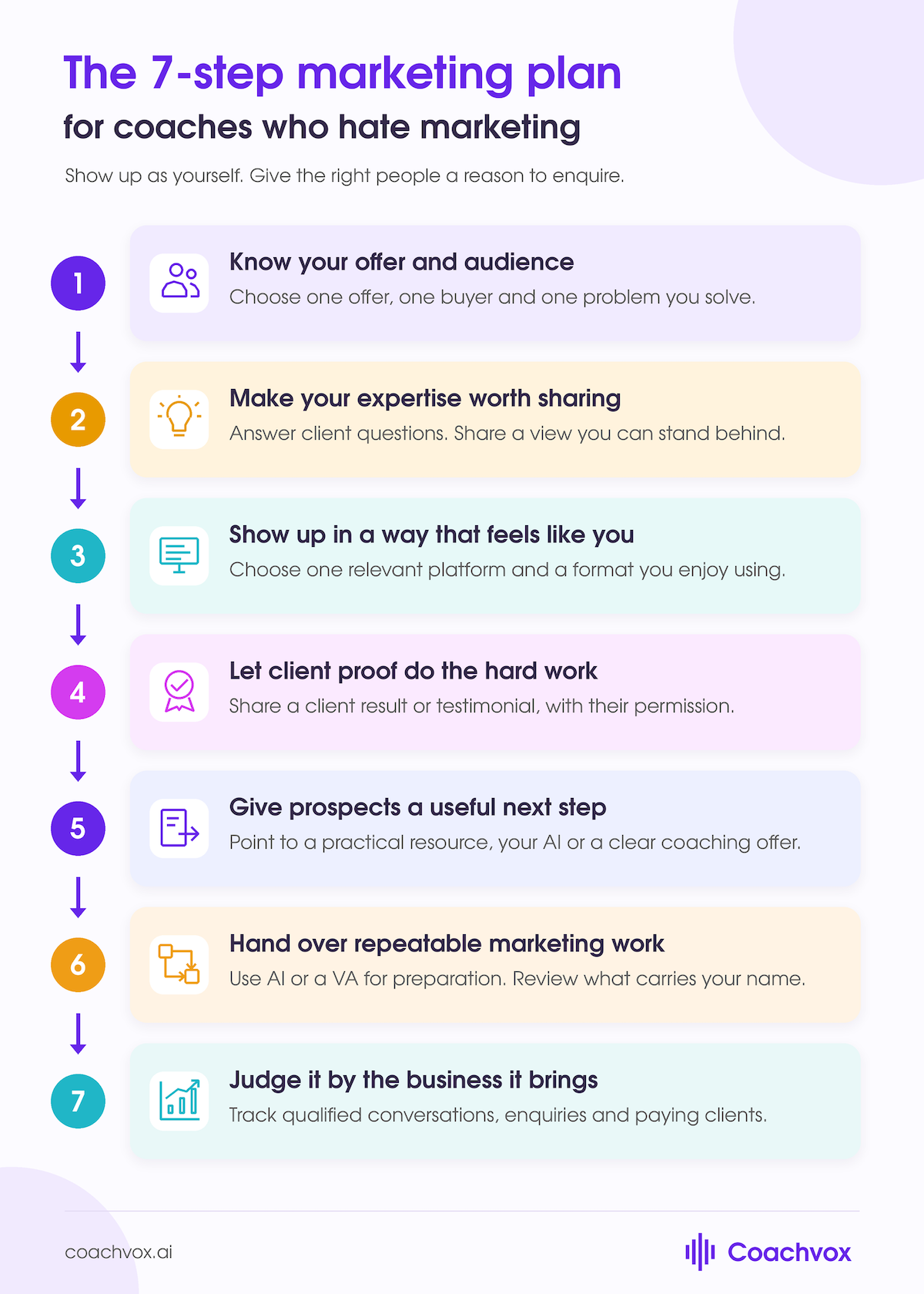
The seven steps above give you a way to market your work that fits your expertise, personality and available time. Use them to make a plan. If you’re still finding reasons to postpone it, be honest about what feels uncomfortable.
You’re worried it won’t work. Publishing something and getting little response feels exposing. Keeping it unpublished saves you that experience, but guarantees nobody benefits from it. Give yourself permission to test an approach and improve it. You’ve done that with plenty of other parts of your business.
You’re worried people will think less of you. Whose opinion are you imagining? A former colleague? Another coach? Consider what you’re actually proposing to publish: a useful explanation, a considered opinion or evidence of work you’re proud of. Would you lose respect for a professional who shared something like that?
You feel you shouldn’t have to. You’ve earned your reputation, and having to keep demonstrating your expertise can feel beneath you. Unfortunately, your future clients haven’t been present for the last fifteen years of excellent work. They need a way to discover what your existing clients already know.
Some discomfort comes with doing something unfamiliar in public. Choose something you’d happily explain to a prospective client, put it into a format that suits you and publish it. Let yourself get used to being seen without requiring every post to justify your entire professional reputation.
People who would benefit from your coaching need a chance to find you. Keeping useful knowledge out of sight leaves them with fewer reasons to consider your help. You get to choose how you show up. Following through is part of running the business.
Coachvox lets you create an AI version of yourself, trained on your expertise, methods and communication style. It gives prospects a way to explore your thinking and helps you create content from the knowledge you’ve spent years developing.
With Coachvox, you can:
Give people a useful invitation. Share your AI as a lead magnet so prospects can explore their challenges using your approach.
Demonstrate how you think. Let potential clients experience your questions and perspectives before booking a discovery call.
Keep the conversation going. Your AI engages visitors and captures contact details while you’re busy coaching.
Create content with your expertise behind it. Draft LinkedIn posts, articles and social content using your existing knowledge.
Keep your voice recognisable. Review and edit drafts built around your communication style, rather than explaining yourself from scratch every time.
Find subjects your audience cares about. Use insights from AI conversations to understand what people want help with.
You still give people a reason to find you. Your AI gives them more to explore when they do, and more of your own thinking to encounter between posts. Start now:
You can build a credible online presence around the coach you already are. Explain something useful. Share an opinion you can defend. Let prospective clients see the judgement and experience they’d be paying for. Promoting work you believe in is a reasonable thing for a business owner to do.
Choose one question your ideal clients keep asking and answer it in a format you’re comfortable publishing. Give interested readers a clear next step, then follow through when they respond. You’ve spent years doing work worth knowing about. Make it easier for the right people to find it.
You can win clients through speaking, referrals and directories. But relying on those routes alone limits how widely your work gets known. Someone who receives your name can still look you up on social media, explore your thinking and compare you with coaches they already follow.
If you want to become an in-demand coach, give social media a serious place in your marketing. Being absent leaves prospective clients with fewer opportunities to discover you and fewer reasons to remember your name.
No. Choose a platform where your ideal clients spend time. Ideally, you enjoy using it too, although there may be a trade-off. Being comfortable on a platform your buyers never visit won’t get you very far.
Learn how your chosen platform works. Spend a few hours reading current guidance, study relevant accounts and test your own content. Get help if you need it. Understanding one platform properly is a more manageable job than keeping five accounts vaguely alive.
Promote your work in a way you’re comfortable putting your name to, then treat it like any other part of running the business. Make a plan and follow through. There’s nothing embarrassing about helping prospective clients understand why they might hire you.
If you’re still cringing, ask what you’re worried people will think. Would you judge another experienced professional for sharing useful knowledge? You may be applying a much harsher standard to yourself than anyone else is.
Yes. Written posts, carousels, articles and practical resources let you demonstrate expertise without appearing on camera. Choose a format that suits how you explain things well. If you want to try video, practise with a familiar client question and a simple recording setup. Filming Reels is an option, not an entrance requirement.
No. Some coaches find personal stories help prospective clients relate to them. How useful that is depends on your audience, niche and what you choose to share. You get to set the boundaries.
Your personality also comes through in your opinions, examples and how you respond to people. Prospects can get a good sense of you through your professional thinking. Sharing your entire weekend is optional.
There are no hard and fast rules. On LinkedIn, try three to five useful posts a week, then adjust according to the response and the time involved. Give yourself enough practice to learn which subjects and formats work.
If video suits you, Instagram’s Trial Reels let you test content with non-followers before sharing the strongest examples with your followers. That gives you a way to experiment before putting everything in front of your existing audience.
Keep the content worth reading or watching. Publishing AI slop to hit a posting target does your reputation no favours. See why AI-generated content isn’t winning coaching clients.
Low engagement says little on its own about your coaching ability. Check who saw the post, whether relevant conversations followed and what prospects mention when enquiring. Some buyers read without reacting publicly. A disappointing response is something to investigate, rather than a reason to disappear.
Expect a learning period. You’re finding the subjects, openings and formats that connect with your audience. When you find a theme that works, explore it further. Progress can become much faster once you have something specific to repeat and improve.
Yes, but review every draft before publishing it. Read it aloud. Does it sound like you? Does it contain an opinion, example or explanation that reflects your experience? Remove anything you wouldn’t say to a client. Polished sentences alone don’t make a post worth reading.
Tools such as Coachvox can draft from your expertise and communication style. You still decide what gets published. Recognisable AI filler makes your work look interchangeable, which is a poor way to promote years of specialist experience.
Yes. Coachvox lets you train an AI version of yourself on your content, methods and communication style, then use that knowledge to draft posts and articles. Give it your frameworks, considered opinions and examples of your writing. The more of your actual thinking it has to work with, the more useful the starting point.
Review each draft for accuracy, personality and relevance. Your AI does the preparation; you approve what represents you.
Yes. Coachvox gives prospects access to an AI version trained on your content and coaching methodology. They can explore a challenge, encounter your frameworks and get a sense of how you approach their situation. That gives them more experience of your work than a profile description alone.
Share your AI as a lead magnet through your website and relevant posts. It can engage prospects and capture contact details while you’re unavailable, helping build familiarity with your approach before a discovery call. You still need to give people a reason to find it.
Look at your pipeline. Can you see where your next suitable clients are coming from? If the answer is no, marketing needs more attention. That might mean improving what you’re doing, increasing the time you spend or getting help with a specific problem.
Aim to get routine social media work below an hour a day once your approach is working. That becomes more realistic when you know your platform, understand which content lands and use AI to prepare drafts. Allow additional time upfront to build that system. Scrolling and wondering what to post is where the hours disappear.
Yes. A larger audience of relevant people gives your expertise more opportunities to be seen and recommended. But a huge following filled with people who will never buy your coaching can be commercially disappointing. Look at who you’re attracting as well as how many.
Create content for the broadest relevant version of your ideal client. Cover problems and ambitions they share, then use specific examples to demonstrate your expertise. Going so narrow that very few people recognise the subject can limit reach; broad motivational content can attract almost anyone. Aim for wider appeal within the audience you actually want to serve.