Support clients between calls, protect your methodology, and reduce the extra messages that eat into your week.
Your coaching sessions are effective. Your clients leave with clarity, actions, and a better way to think about their situation. But the real test happens after the call, when they have to apply your work without you there.
If they get stuck, they have two obvious options. They can message you, which gives them support but adds more work to your week. Or they can look elsewhere: ChatGPT, YouTube, someone else’s download. Then they start mixing your method with advice that was never designed for them. This is where AI client support for coaches becomes useful: it gives clients a way to access your thinking between sessions, without more calls, more WhatsApp messages, or a weaker client experience.
The value of coaching is tested between calls. Your client has to use the insight, make the decision, have the conversation, or follow through when the session is no longer fresh in their mind.
A client can leave the session clear and still struggle to use the work three days later. Real situations bring pressure, emotion, deadlines, and other people’s reactions into the mix.
This is often when they need access to the way you would help them think. They may need a reminder of the framework, a better question to ask themselves, or a way to choose their next step. Timely support based on the way you already coach them can keep the work moving between calls.
Being available between sessions feels like you’re providing a good service. A quick WhatsApp reply here, a voice note there, a short email after dinner. No big deal, right?
But over time, those small extras change the shape of the engagement. You are being paid for the session, then giving away more thinking, reassurance, and support around it. When those moments keep expanding without a clear system, your real rate of pay falls.
If clients cannot access your thinking between sessions, they will seek support somewhere else. They might ask ChatGPT, watch another coach’s YouTube video, download a worksheet, or borrow a framework that sounds useful in the moment.
That creates confusion. They start mixing your method with advice from people who do not understand their goals, their history, or the work you have already done together. If that outside advice feels easier to access than yours, confidence in the process weakens.
Clients value coaching when they can use it in the moments that matter. A session gives them direction. Between-session support helps them apply that direction when life gets messy.
This improves the client experience without adding more calls to your calendar. Clients feel better supported, arrive at sessions with clearer thinking, and get more from the work they are already paying for. For a coach with strong client results, that kind of support is a potent retention tool.

AI client support means giving clients access to your thinking between coaching sessions. It should reflect your methodology, your frameworks, your questions, your language, and the way you help people make decisions. The best version is support shaped by the work they are already doing with you.
A worksheet, framework, or client portal can give them the material. An interactive AI version of you helps them apply that material to the situation in front of them. If a client is preparing for a difficult conversation, reviewing a commitment, or trying to make sense of a setback, they need more than a document.
That is the real role of AI support between coaching sessions. It gives clients a way to keep using your coaching when you are not personally available. Done well, it protects your method, reduces repeat messages, and makes the client experience feel more complete.
The strongest version of client support uses an AI version of you, trained on your content, methodology, and coaching style. In Coachvox, that means building an AI your clients can speak to when they need help applying your work between calls.
Begin with the questions and situations that already show up between sessions. Look through WhatsApp messages, emails, call notes, community questions, and client check-ins. You are looking for the moments where clients need your thinking before the next scheduled call.
These support moments are the best place to start training your AI. They show where clients get stuck, what they ask repeatedly, and which parts of your methodology need more explanation. If a client often asks how to prepare for a difficult conversation, use that as a training example. If they keep asking how to apply a framework after a setback, train the AI on that too.
Strong client support depends on how well your AI understands your method and how you communicate it. Train your AI with text-rich material that explains your thinking clearly: books, articles, blog posts, newsletters, workshop notes, course lessons, presentation scripts, client FAQs, and written answers to common questions.
In Coachvox, use “Advanced coach mode” to explain your methodology, frameworks, principles, and approach in more detail. This is where you can describe how your work fits together, when you use a particular framework, how clients should apply it, and what you want the AI to keep in mind when supporting them.
This works alongside your “personality and tone of voice” section. Together, those areas help the AI understand the substance of your coaching and the way you would usually express it.
Useful details to include:
Once trained, test your AI with the situations clients already bring between sessions. Use the support moments you mapped earlier: preparing for a difficult conversation, applying a framework after a setback, reviewing a decision, or deciding what to bring to the next call.
In Coachvox, use fine-tuning to rate responses and improve answers. Ask your AI a realistic client question, read the answer as the client would, then check how well it reflects your method, tone, and boundaries. If the answer isn’t perfect, edit it to exactly what it should say.
Clients need a clear frame before they start using your AI. Tell them what it is useful for, how it fits into the coaching relationship, and when they should come back to you directly.
Give them a short usage guide. For example, you might tell them to use your AI to prepare for a session, apply a framework, reflect on a difficult conversation, review a commitment, or think through a decision before they act.
You should also give them clear boundaries. Tell them which topics need your direct input, which decisions should wait for the next session, and which areas sit outside the scope of AI coaching. This protects the client and keeps the AI in the right role.
Clients will get the most from your AI if you show them how to use it. Give them a small set of prompts they can copy, adapt, and use when they need support between sessions.
These prompts should guide the client back into your method. They should help the client explain the situation clearly, reflect before acting, and connect their current problem to the work you have already done together.
For example:
I’m dealing with [specific situation] and I want to respond in a way that fits the work I’m doing with [coach name]. Ask me up to five questions to help me understand what is really going on, what I might be assuming, and what my next step should be.
I’m trying to apply [framework or principle] to [current challenge]. Help me work through it step by step. Start by checking whether I understand the framework properly, then help me apply it to the decision or conversation in front of me.
I have my next coaching session coming up and I want to make better use of it. Based on what I share, help me identify the main issue, what I have already tried, where I feel stuck, and the best questions to bring to the session.
Good prompts keep the AI focused. They also teach clients how to use the support well, which makes the experience more useful from the start.
Client conversations with your AI can show you where people get stuck between sessions. Review the themes regularly and look for repeat questions, unclear resources, missing explanations, or parts of your methodology that need more support.
If several clients ask the same question, that may need a better resource. If they misunderstand a framework, explain it more clearly in your training material. If they keep raising the same issue before a session, use that insight to prepare better questions for the call.
This turns AI support into a feedback loop. Clients get help between sessions, and you get a clearer view of what they need from your coaching.

Each coaching business will use AI support differently, but the job is the same: help clients apply your thinking between calls.
An executive coach can use AI support to help clients prepare for difficult meetings, review leadership decisions, or think through pressure before a board presentation.
The client can organise their thinking before they act. That might mean clarifying the real issue, testing their assumptions, or preparing the points they want to raise in the next session.
A business coach can use AI support when clients need to apply a pricing framework, review an offer, prepare for a sales call, or make a clearer decision about where to focus next.
This is useful when clients understand the strategy during the call, then hesitate when they need to use it. The AI gives them a way to revisit your method before they start second-guessing the work or looking elsewhere.
Leadership clients often need support right before a conversation happens. They may be preparing to give feedback, delegate more clearly, handle conflict, or communicate a decision to their team.
AI support can help them think through what they want to say, what reaction they might face, and how to stay aligned with the leadership behaviours you are helping them build.
A health, habits or performance coach can use AI support for reflection, planning, accountability, and reviewing progress between check-ins.
The boundaries need to be clear. The AI can support habit review and decision-making around agreed goals, but medical, clinical, or high-risk issues need the right professional input.
In a group programme, AI support can help members apply the material without turning the coach into the help desk for every question.
The AI can answer repeat questions, point members back to the right framework, and help them prepare better questions for live calls. That gives clients faster support and keeps the coach focused on higher-value teaching and feedback.
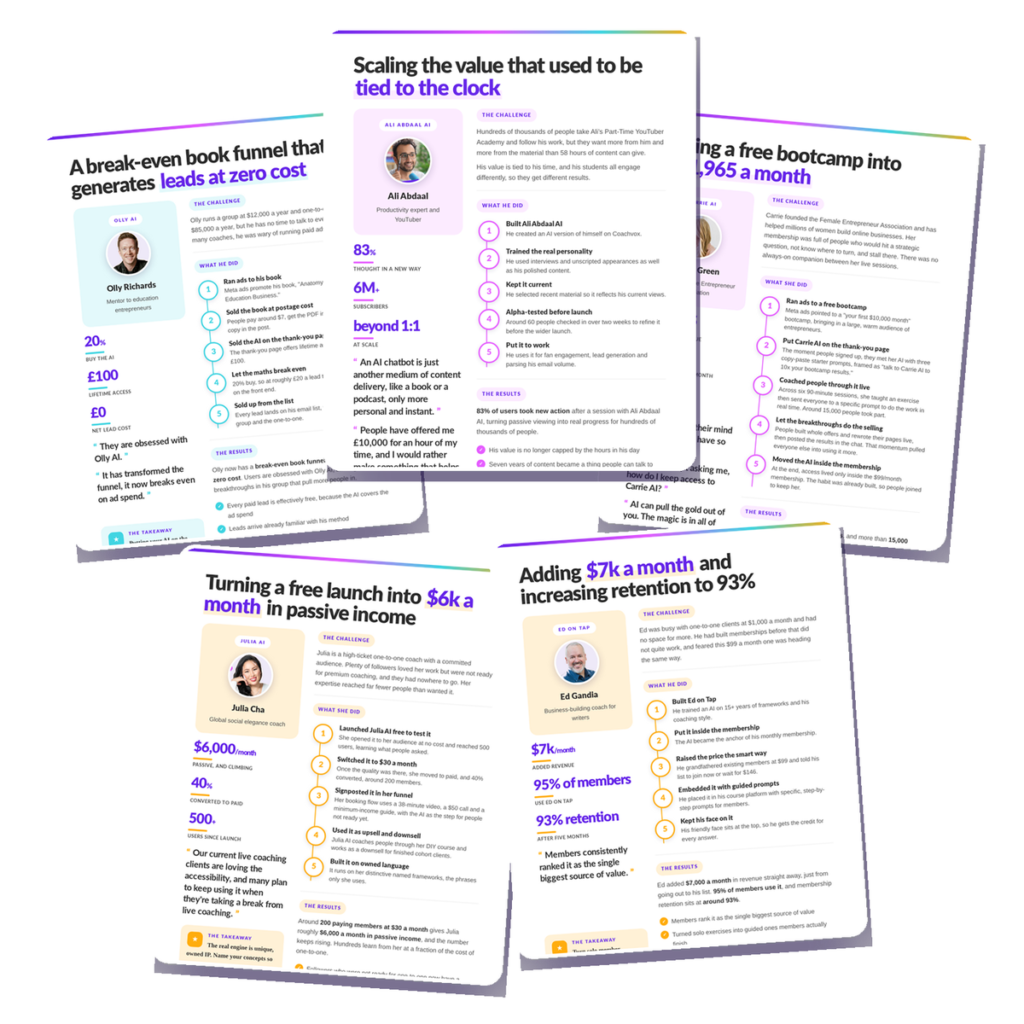
Coachvox helps you create an AI version of you, trained on your content, methodology, and coaching style. Your clients can use it between sessions to ask questions, apply your frameworks, and get support that reflects the way you already coach.
With Coachvox, you can:
Your coaching still leads the relationship. Coachvox gives clients a way to keep using your work when you are not personally available.
Start your free trial here:
Clients get more value from coaching when they can use your thinking at the moment they need it. That could be before a difficult conversation, after a setback, or when they are trying to apply your framework without another call in the diary.
Choose the five questions clients ask most often between sessions. Then decide which of those your AI could answer most effectively. The better clients can use your work between sessions, the stronger the coaching experience becomes.
AI client support for coaches means using AI to help clients between coaching sessions. The strongest version is trained on the coach’s own methodology, content, frameworks, and tone of voice.
This gives clients a way to ask questions, reflect on situations, and apply the work when the coach is not personally available.
AI can support coaching clients between sessions by helping them prepare, reflect, apply frameworks, and think through next steps. It gives clients access to useful support when the next call is still days away.
For example, a client might use AI to prepare for a difficult conversation, review a decision, revisit a framework, or decide what to bring to the next session.
Between-session support is the help a client receives between scheduled coaching calls. It may include prompts, worksheets, messages, check-ins, resources, or an AI version of the coach.
The aim is to help the client keep using the coaching in real situations. Strong between-session support makes the work easier to apply and reduces reliance on extra calls or ad hoc messages.
AI for coaching clients works well when it is trained on the coach’s own method and used with clear boundaries. It gives clients a useful support layer without asking the coach to be available for every question.
The risk comes from generic AI advice. A client support AI should reflect the coach’s approach, use the right language, and guide the client back to the work they are already doing; not just whatever comes out of ChatGPT!
AI should support the work around coaching sessions. Human coaching is still needed for judgement, accountability, emotional nuance, complex decisions, and deeper client work.
Used well, AI helps clients arrive at sessions better prepared. It can also reduce repeat questions between calls, which protects the coach’s time without weakening the client experience.
An AI coaching assistant should answer questions linked to the coach’s methodology, frameworks, resources, and agreed client work. It is useful for reflection, preparation, implementation, and repeat questions.
In general, anything involving risk, crisis, medical advice, legal advice, financial advice, therapy, safeguarding, or major personal decisions should be handled by the human coach or another qualified professional.
Train AI with text-rich material that explains how you think and coach. Useful material includes books, articles, newsletters, workshop notes, course lessons, presentation scripts, client FAQs, and written answers to common questions.
For Coachvox, you can also use “advanced coach mode” to explain your methodology, principles, frameworks, and coaching style in more detail. Fine-tuning then helps improve how the AI responds to real client scenarios.
Coaches protect trust by being clear about how the AI should be used. Clients should understand what the AI is for, where it fits into the coaching relationship, and when they should contact the coach directly.
Trust also depends on quality. The AI should be trained on the coach’s real work, tested with realistic scenarios, and reviewed over time.
Yes. Coachvox helps coaches create an AI version of themselves that clients can use between sessions.
The AI can be trained on the coach’s content, methodology, and tone of voice. Clients can use it to ask questions, apply frameworks, prepare for sessions, and get support that reflects the coach’s actual approach. The coach can then review all the transcripts to the benefit of the client.
Coachvox is designed to create an AI version of the coach, trained on their content, methodology, and coaching style. ChatGPT gives general answers unless the client knows exactly what context to provide.
For coaching client support, that difference is important. A Coachvox AI keeps clients closer to the coach’s method, while generic AI pulls them towards advice that does not fit the work they are already doing.