How to use your online presence to build trust, generate leads, and grow your coaching business
Some coaches already get most of their clients from social media. They have the Instagram funnel, the LinkedIn audience, the paid ads, the short-form video machine, the works. Great for them. If that is your business, you probably do not need this article.
This is for the coach who still gets plenty of work through referrals, podcasts, search, speaking, partnerships, or people passing their name around. That can still be incredibly effective. But in 2026, those prospects are checking your social media presence before they enquire, reply, book, or buy.
They may also be finding coaches on social media more than you think, even if your audience feels more relationship-driven. This article will show you why your social media presence deserves more attention, what it needs to prove, and how to build one without turning your coaching business into a content treadmill.
Social media is now part of how people find, judge, and remember coaches. A weak presence makes that harder than it needs to be.
A referral can open the door, but it rarely does the whole job. Someone hears your name, likes the sound of what you do, then starts quietly checking whether you look like the right person to help them.
They might look at your LinkedIn profile, Instagram page, recent posts, comments, podcast clips, client wins, or anything else that gives them a feel for your thinking. If they find clear evidence of your expertise, the referral gets stronger. If they find a half-baked profile and three posts from 2022, you have made the buying decision harder than it needed to be.
People are searching for coaches on social platforms, especially when the problem feels personal, urgent, or hard to explain in a Google search. The algorithm is already showing them content linked to the challenges, doubts, goals, and decisions they are thinking about. Coaching sits right in that territory.
Coaches also have an advantage because the person is the business. On LinkedIn especially, a strong personal profile often makes more sense than a company page. They watch a short video, read a comment, click through a profile, and start forming an opinion. If your profile gives them a clear reason to stay, your social media presence has done the first job: it has made you discoverable to the right person at the right moment.

Your prospects know how easy it is to publish generic advice now. They have seen the posts that sound polished but say very little. They have probably used ChatGPT themselves, so they can feel when content has no real judgement behind it.
That gives serious coaches an advantage, but only if their social media presence shows their thinking clearly. Share the way you diagnose problems. Talk about what you notice in client work. Explain the decisions you would make and the ones you would avoid. The more specific your thinking is, the harder it is to mistake you for another coach posting ‘meh’ advice from the same prompt.
Your website still has a job. It explains who you help, what you offer, and how someone can take the next step. But a website is usually too polished and static to show how your thinking works day to day.
Social media gives prospects more current signals. They can see what you are talking about this month, how you respond to people, what ideas you keep returning to, and whether your work still feels relevant. A good website can make you look credible. A good social media presence makes you easier to trust.
Social media acts as a multiplier for the attention you already get elsewhere. A podcast listener can hear you for 40 minutes, then spend another hour going through your posts. A referral partner can send someone to your profile instead of trying to explain your work from scratch. A journalist, event organiser, or potential collaborator can quickly see your angle, your credibility, and the audience you speak to.
Interest happens before they’re ready to buy. Someone may like your podcast interview but feel too early for a call. If your social media presence gives them useful posts, a lead magnet, a newsletter, a low-cost product, or an AI version of you to try, they can move further into your world without needing to make a big decision.
Once social media has a clear job, it becomes easier to use well. The aim is to make your expertise obvious to the right people before they ever speak to you.
Your social media presence needs a role. Otherwise, you end up posting because you feel vaguely guilty about not posting, which is not an effective growth strategy.
For one coach, social media might be the main discovery channel. For another, it might support referrals, warm up podcast listeners, grow an email list, or give prospects proof before a discovery call. Decide what you need it to do first. Then build the profile, content, and next step around that job.
Your profiles should make your dream client feel they have found someone relevant. That means being clear about who you help, what problem you solve, why your approach is different, and what they should do next.
This is especially important for coaches because prospects are assessing you as a person. Your profile should quickly show your niche, your credibility, your point of view, and enough proof to make someone dig deeper. If your ideal client has to work too hard to understand why you are relevant, they’ll move on.
Your best social content should come from your actual coaching work. Use your frameworks, diagnostic questions, client patterns, decision-making process, and signature ideas. These are the things that show how you think.
This is where established coaches have a real advantage. You are not trying to invent content from scratch every day. You already have IP sitting inside client calls, workshops, notes, slides, exercises, and old posts. Bring that thinking into public view so prospects can see the method behind the result.
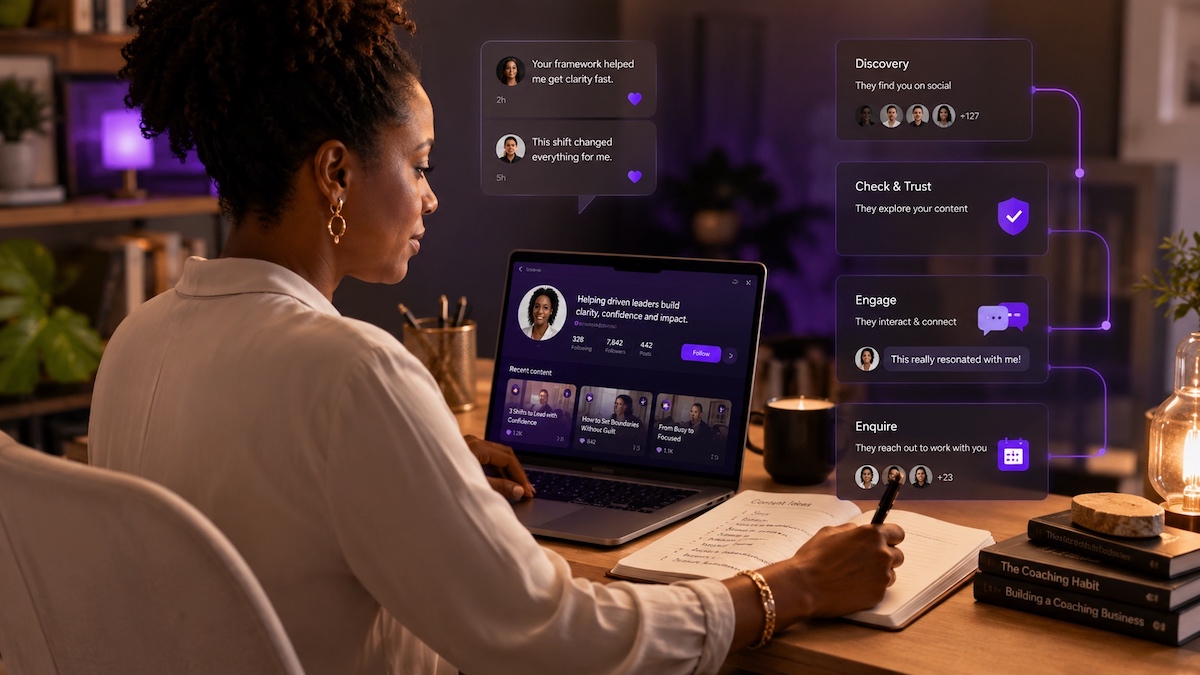
Social proof is one of the fastest ways to reduce doubt, especially when someone is still deciding whether you are the right coach for them. It should show up across your presence: posts, LinkedIn about section, banner imagery, featured links, case studies, podcast clips, screenshots where appropriate, speaking photos, and examples of your work in action.
The best proof feels natural. A positive comment from a client. A strong before-and-after from your work. A specific result from a workshop. A post explaining a mistake you helped a client avoid. You are giving prospects enough evidence to think, “Yes, this person knows what they are doing and others agree.”
A powerful social media presence needs repetition. If you say something once, most people will miss it. If you say it clearly, often, and from different angles, people associate you with that idea. Not only should you aim to own a phrase in your clients’ minds, but you need a take on it.
This is where opinion is key. Share what you believe about your niche. Say what you think your clients get wrong. Challenge weak advice. Explain the standards you hold. Some people will disagree, which is fine. The right people will feel like they have found their coach.
Someone can like your content and still be nowhere near ready to book a call. Give them another step. A lead magnet, newsletter, webinar, tripwire product, diagnostic tool, or AI version of you can help them move closer without asking for too much too soon.
This is where social media feeds your wider ecosystem. The post creates attention. The next step captures interest. Then your funnel, email sequence, or automation can keep the relationship moving after they leave the platform. Without that next step, too much attention disappears back into the feed.
You do not need to create a brand-new idea every time you post. Take one strong point from your methodology (or an existing post that performed well) and turn it into several useful assets: a LinkedIn post, a YouTube short, an email, a carousel, or a blog article.
AI is very effective at repurposing content. Feed it your idea or original post, and explain all the different formats you’d like content for. Ideally, set up a project on ChatGPT or Claude so it gets your voice right every time.
Follower count is an easy number to watch, but it does not tell you enough. A smaller audience of right-fit prospects, referral partners, peers, and past clients can be far more useful than a large audience that never takes a step closer.
Look for signs that people trust the work. Comments with real thought behind them. Saves. Shares. Replies. Profile visits. Lead magnet downloads. Newsletter sign-ups. DMs with context. Prospects quoting your posts back to you on calls. Those signals tell you whether your presence is doing the job you chose for it.
Social media helps people notice your ideas. Coachvox gives them somewhere useful to go next.
With Coachvox, you create an AI version of you trained on your content, methodology, frameworks, and way of thinking. Add it to your profile links, website, lead magnet, course, membership, or sales funnel, so people can experience your expertise before they book a call.
Smart coaches use Coachvox to:
Start your free trial today. Set up takes less than an hour.
You do not need to be the coach who lives on social media, posts five times a day, and treats every thought as content. Start with the platform your best prospects already use. Make your profile compelling, showcase your methodology and client results, share your strongest points of view, and give people an obvious next step.
Your social media presence should make it easier for the right person to understand why they should trust you. If someone hears your name, finds your profile, and still cannot tell what you stand for, the work is not done. Get to work.
Yes, coaches need a social media presence in 2026 because prospects check social profiles before they enquire, book, or buy. Even if most of your work comes through referrals, your social presence can help prove your expertise before a sales conversation.
A good social media presence for coaches clearly shows who you work with, what problem you solve, how you think, and what action someone should take next. Your profile, posts, proof, and links must all contribute to this. Consistency is key.
The best social media platform for coaches in 2026 depends on where your ideal clients spend time and how they prefer to engage. LinkedIn often works well for business, executive, leadership, and career coaches. Instagram can work well for coaches whose work is more visual, personal, lifestyle-led, or community-driven.
Coaches can use LinkedIn to share their methodology, publish opinions, show client proof, build referral relationships, and make their expertise easier to find. For many coaches, a personal profile is more useful than a company page because prospects are judging the person behind the work.
Coaches can use Instagram to show their personality, explain their ideas visually, share client results, build daily familiarity through Stories and Shorts, and move followers into a lead magnet or email list. It works best when the profile makes the coach’s niche, offer, and next step clear.
Coaches should post content that shows their thinking, methodology, client patterns, beliefs, and proof. Useful posts include diagnostic questions, short frameworks, strong opinions, anonymised client lessons, common mistakes, and explanations of how you approach a problem.
Coaches should post often enough to stay visible without turning content into a full-time job. 3-5x per week should be your aim, but a realistic rhythm you can maintain is better than a burst of daily posting followed by silence. The goal is to build trust through repeated useful ideas.
Social media helps coaches get clients by making their expertise easier to discover, assess, and remember. It can warm up referrals, feed lead magnets, grow an email list, support sales calls, and give prospects proof before they speak to you.
Yes, coaches can grow their business on social media without becoming influencers. You do not need a huge audience to make social media useful. A smaller audience of right-fit prospects, referral partners, peers, and past clients can support enquiries, partnerships, and sales conversations.
Coaches can turn social media followers into leads by giving them a clear next step. That might be a lead magnet, newsletter, webinar, diagnostic tool, tripwire product, or AI version of you. Coachvox can help here by giving followers an interactive way to experience your thinking and share their contact details.
Coachvox helps coaches turn social media attention into deeper engagement. You can link to an AI version of you from your social profiles, posts, website, lead magnets, or sales funnel so prospects can ask questions, experience your coaching style, and join your list before they book a call.
Coaches should track signs of trust and buying interest, not only reach. Useful signals include thoughtful comments, saves, shares, replies, profile visits, email sign-ups, lead magnet downloads, DMs with context, and prospects mentioning your content on calls.