Convert your audience into buyers by bridging the gap between freebie and high-ticket offer
You’ve built up an audience. You’re creating content, you might have people on a mailing list, and you know your coaching gets results. But there’s a gap between the people who follow you or download something for free and the ones who actually pay you. Most coaches try to jump straight from “here’s something free” to “here’s my $3,000 programme” – and wonder why the conversion rate is so low.
A tripwire funnel fills that gap. It’s a proven sales and marketing tactic that coaches at every stage (from those building their audience to those already doing strong numbers) can use to generate consistent revenue, build a list of buyers, and make the path to high-ticket coaching a much shorter walk. By the time you’ve finished reading this, you’ll know exactly how a tripwire funnel works and how to get one up and running.
A tripwire funnel is a short sequence that turns someone who’s just shown interest in your work into a paying customer quickly. It starts with a free offer (your lead magnet) that gets someone onto your list, then immediately presents them with a low-cost product, typically priced anywhere from $9 to $99, that delivers serious value for the price. That product is your tripwire. After they buy, an automated email sequence does the work of nurturing them toward your main offer.
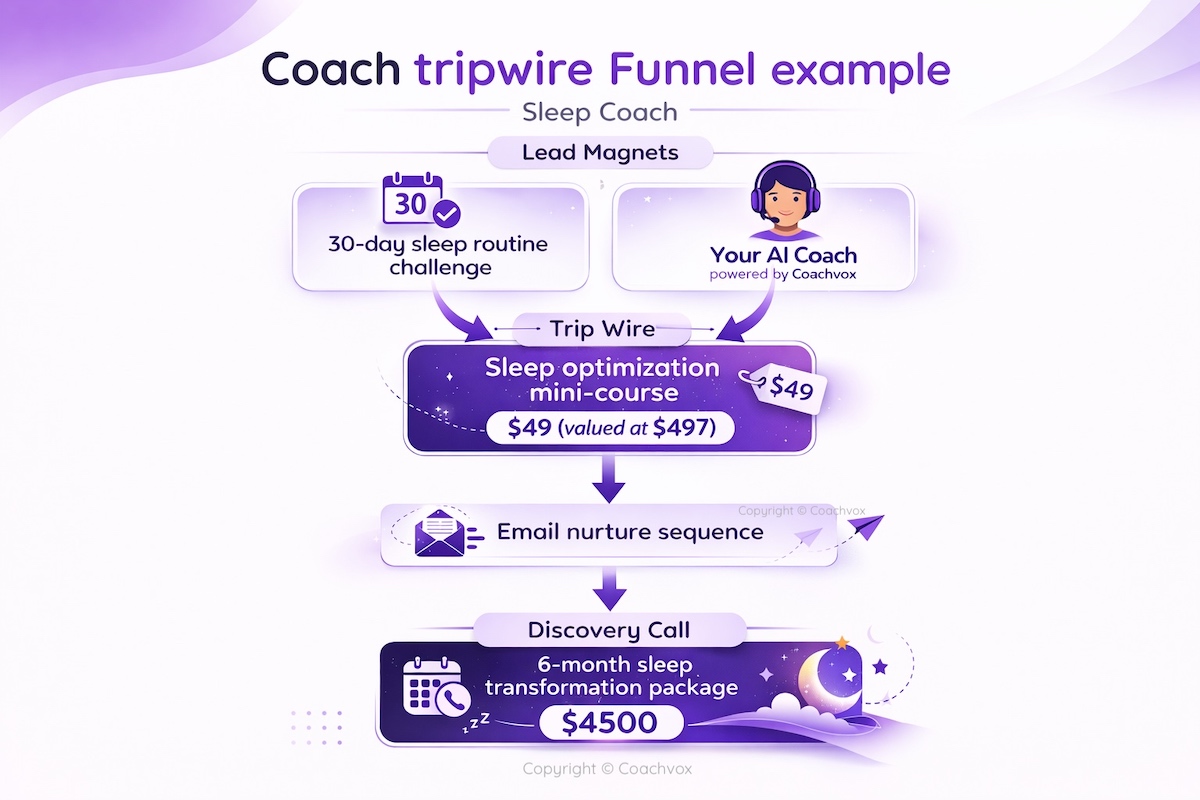
Here’s what that looks like in practice. A sleep coach offers two free lead magnets: a 30-day sleep routine challenge and an AI sleep coach built with Coachvox, available on her website around the clock. Both point to the same tripwire: a sleep optimisation mini-course priced at $49, with a real value of $497. Everyone who buys it enters an email sequence that, over time, introduces her six-month sleep transformation programme at $4,500. One funnel. Two entry points. A clear path from curious to committed.
Most coaches are sitting on an audience that’s much more valuable than they’re monetising right now. A tripwire funnel changes that, and the reasons it works so well go deeper than you might expect.
Asking someone who just downloaded your free guide to commit to a $5000+ coaching programme is a big ask. They don’t know yet whether you deliver. They haven’t spent any money with you. The psychological distance between “free” and “thousands of dollars” is enormous, and most people won’t make that leap no matter how good your content is.
Although it sounds tiny, a $49 offer sitting in between changes the whole picture. It’s a decision that takes seconds, not weeks. Your ideal client gets a genuine taste of your expertise, and you get a buyer – someone who’s raised their hand and said they’re willing to invest in solving this problem. That’s a completely different relationship to a subscriber.
There’s a difference between someone who’s read your content and someone who’s paid for it and got results. When a client spends $49 on your mini-course and comes away thinking “that was worth ten times what I paid,” you’ve done something no amount of free content can do; you’ve shown them what a financial transaction with you looks like.
That experience carries serious weight when they’re considering your high-ticket programme. They’re not wondering whether you’ll deliver. They already know.
Once someone buys from you, even something small, the relationship shifts. Now they’re a customer. And customers buy again. Research into buyer behaviour consistently shows that the hardest sale is always the first one. After that, the barrier drops significantly.
This is why a well-priced tripwire can be the start of a long and valuable client relationship. Someone who buys a low-ticket offer from you is far more likely to say yes to your next offer, whether that’s another product, a group programme, or a one-to-one package.
Not everyone in your audience can afford high-ticket coaching, and that’s fine. A tripwire lets you serve those people and get paid for it, rather than leaving that part of your audience completely unmonetised. If you have a list of several thousand people, selling hundreds of low-ticket offers adds up to meaningful income.
This is also a smarter way to think about capacity. If your one-to-one slots are full (or you simply don’t want more of them), a tripwire keeps revenue coming in from the people you can’t take on as clients right now.
Create two different tripwires and track the sales. The one that consistently outsells the other is telling you something important: that’s the problem your audience are willing to pay to solve right now. Your buyers are showing you with their wallets what they care about most, and that insight is worth a lot more than any survey or poll.
You can use that data to shape your content, refine your messaging, and decide where to focus your next offer. Coaches who pay attention to this end up with a much clearer picture of who their audience really is and what they’re actually willing to spend money on.
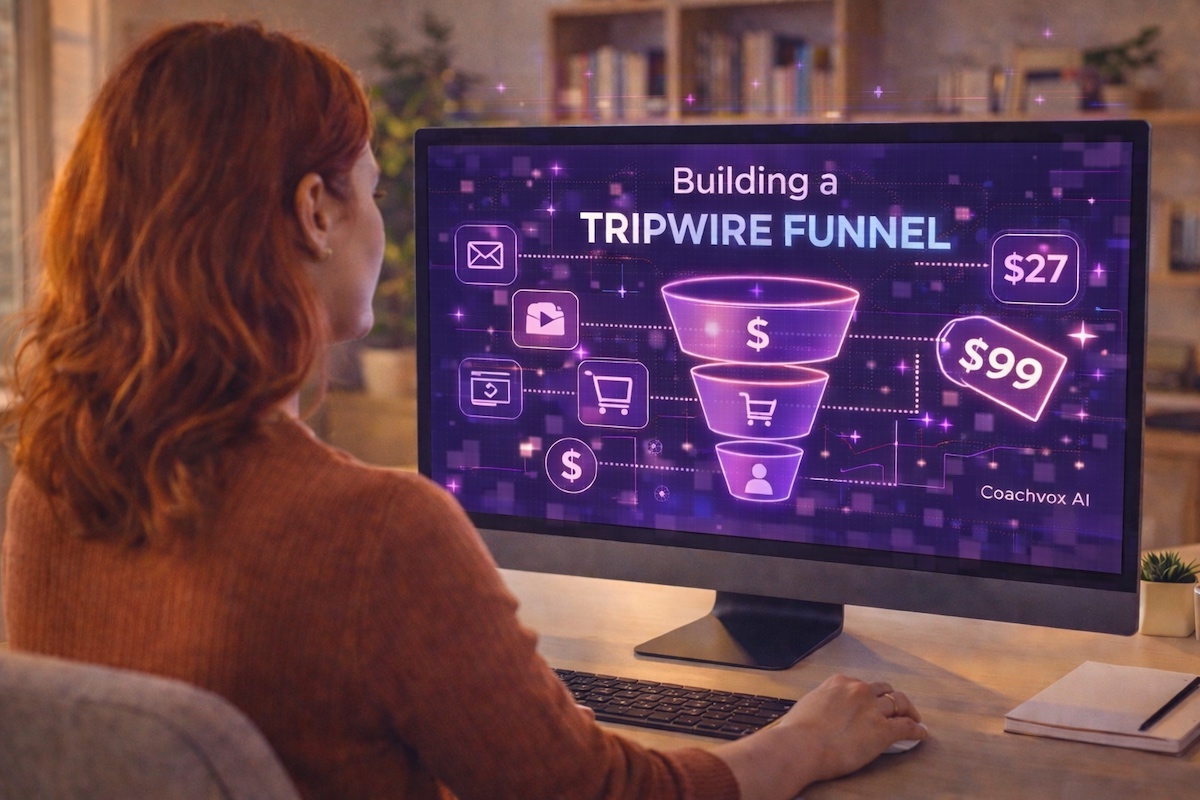
Building a tripwire funnel doesn’t require a big tech stack or a marketing team. You need a few moving parts in the right order, and once they’re in place, the whole thing runs without you.
Before any of the rest of this works, you need a way to bring people into your world and get them onto your list. That’s what a lead magnet does. It’s a free resource (a guide, a challenge, a workshop, a quiz, an AI coach) that solves a specific problem for your ideal client and gives them a reason to hand over their email address.
If you don’t have one yet, start here. A tripwire funnel needs a steady flow of new people entering it, and a lead magnet is what makes that happen. Without it, you’re trying to sell to people who don’t know you yet and have no reason to trust you.
Your tripwire needs to feel like an almost unfair deal. Price it low (most coaches land somewhere between $27 and $97) and make the perceived value significantly higher. A mini-course, a workshop recording, a detailed guide, a short group programme; anything that delivers a real, concrete result for your ideal client.
The gap between what someone pays and what they feel they’ve received is what makes a tripwire work. If someone spends $37 and walks away thinking they got $300 worth of value, you’ve done it right. That feeling is what opens the door to everything that comes next.
You need somewhere to take payment, deliver your tripwire, and send buyers to a thank you page. Platforms like ThriveCart, Kajabi, and Teachable handle all of this cleanly and don’t require any technical expertise to get started. Pick one, set up your product, and make sure the delivery is automatic so you’re not manually sending anything to anyone.
Keep the checkout process as simple as possible. Every extra click or form field between someone deciding to buy and actually completing the purchase is an opportunity for them to change their mind. (This process is smoothest if this is the same platform you use for your lead magnet.)
The moment someone signs up for your free offer is the best moment to show them your tripwire. They’ve just told you they want help with this problem; they’re engaged, they’re on your page, and they haven’t clicked away yet. A thank you page that presents your tripwire as a limited-time offer catches them at exactly the right time.
Keep the copy on that page focused and direct. Explain what the tripwire is, what it will do for them, and why the price is a straightforward decision. You don’t need a long sales page here; a few clear paragraphs, social proof, and a strong call to action are enough.
Not everyone buys on the thank you page, and that’s fine. An automated email sequence gives you another opportunity to present the tripwire to everyone who signed up for your lead magnet but didn’t purchase. Keep it short (two or three emails over 24 to 48 hours) and frame the offer as time-limited so there’s a reason to act now rather than later.
These emails don’t need to be complicated. Ask them how they are getting on with their lead magnet, show them how the tripwire takes them further, and make it easy to buy. A simple, direct email will always outperform an overly long one.
If you already have people on your mailing list, don’t wait for new subscribers to buy your tripwire. Your existing list is warm; they already know your work and have chosen to hear from you. A short sequence of two or three emails introducing your tripwire can generate sales quickly, and those early buyers give you useful proof that the offer works.
This is also a good way to test your tripwire before you have a high volume of new leads coming through. If people who already trust you are buying it, that’s a strong sign that new subscribers will too.
Pro tip: Collect positive reviews and testimonials to use as social proof for the tripwire sales page.
Just as for your lead magnet, once someone buys your tripwire, they need to go somewhere. That somewhere should do more than just confirm their purchase. Your thank you page is the perfect place to introduce what’s coming next, whether that’s a bigger programme or an invitation to book a discovery call. Keep it warm and low pressure; they’ve just spent money with you for the first time.
Follow up with an email sequence over the coming days and weeks. Ask how they’re getting on with the tripwire. Share anything that adds to the value they’ve already received. When the time is right, make the ask. Invite them to take the next step with you.
Buyers who’ve had a great experience with your tripwire are your most receptive audience for your higher-ticket offer. Treat that sequence as a conversation, not a sales pitch.
Once your funnel is running, the numbers will tell you everything you need to know. You’re looking at two conversion rates: how many people who sign up for your lead magnet go on to buy your tripwire, and how many tripwire buyers eventually become coaching clients.
The sale from lead magnet to tripwire should happen fast; either on the thank you page itself or within 24 hours via your email sequence. The price and the offer should make it an easy decision for the right person. If that conversion rate is low, there are a couple of likely explanations worth examining.
You may be attracting the wrong audience through your lead magnet. If the people signing up don’t have the budget or the desire to spend even a small amount on solving this problem, they’re probably not your ideal client. It’s also worth checking whether your lead magnet and tripwire are closely enough connected. If the free offer promises one thing and the tripwire delivers something different, people won’t see the logical next step and they won’t buy.
Apply the same thinking to the second conversion rate. If tripwire buyers aren’t going on to book discovery calls, start by looking at the alignment between what the tripwire delivers and what your coaching programme offers. Is there a clear and natural progression from one to the other? Is the problem your tripwire solves directly related to the bigger transformation your coaching provides?
Also look at whether you’re actually making the ask clearly enough. A nurture sequence that adds value but never invites someone to take the next step will underperform every time. Your buyers are receptive; but they need a clear invitation and a good reason to say yes.
Get your tripwire funnel working with your AI coach
You’ve got the steps. Now here’s something most coaches haven’t considered yet. An AI version of yourself works as an interactive lead magnet that feeds directly into your tripwire funnel; delivering your actual coaching approach and qualifying buyers while you sleep.
Top coaches use Coachvox to capture leads, showcase their work, and scale their impact.
Start your free trial today. Set up takes less than an hour.
A tripwire funnel is one of the most practical things you can add to your coaching business right now. It monetises the audience you’re already building, creates a list of buyers rather than just subscribers, and gives the people who aren’t yet ready for your full programme a way to experience what you do firsthand.
Start with one lead magnet and one tripwire. Get the pages and the email sequences in place, put it in front of your existing list, and see what happens. The funnel compounds over time. Every new subscriber who enters it is a potential buyer, and every buyer is a potential client.
A tripwire funnel for coaches is a short sales funnel that converts new leads into buyers using a low-priced entry offer.
It works by presenting a small paid offer immediately after someone joins your list or engages with your content. That first purchase builds trust, qualifies serious prospects, and increases the likelihood they will later invest in higher-ticket coaching.
A lead magnet collects subscribers, while a tripwire funnel creates buyers.
Lead magnets grow your audience, but a tripwire introduces a paid step. That payment changes the relationship from follower to customer, which dramatically improves conversion rates for future offers.
They reduce the psychological gap between free content and premium coaching.
Most prospects hesitate to jump from free content to a multi-thousand-dollar programme. A small purchase lowers risk, demonstrates your value, and builds buying momentum. This makes tripwires particularly effective for trust-based services like coaching or higher-priced courses.
Most successful tripwire offers fall roughly between $27 and $97.
The goal is not maximum revenue but minimum friction. The price should feel easy to say yes to while still delivering genuine value. If buyers feel they received far more than they paid, they’re much more likely to continue buying.
Offers that deal with one specific issue your ICP faces and delivers a clear result convert best.
Short courses, frameworks, workshops, or structured action plans work well because they solve a specific problem fast. General information products usually convert poorly because they don’t create a strong transformation.
Ideally immediately or within the first 24–48 hours.
Interest and intent are highest right after someone signs up or interacts with your content. Presenting a tripwire at that moment captures attention while motivation is strong, which significantly improves purchase rates.
Yes — that’s one of its biggest advantages.
Tripwire funnels monetise your audience regardless of whether they become high-ticket clients. This creates an additional income stream while still serving people who may not yet be ready for deeper coaching. It may also provides clues for a mid-level offering that helps you scale beyond your time.
The best lead magnet attracts buyers, not just subscribers.
Choose a lead magnet closely tied to the same problem your paid offer solves. Interactive tools, diagnostics, and conversational experiences often perform well because they engage users immediately and identify their needs.
Yes – Coachvox can function as the lead-generation entry point.
Coaches use Coachvox to create an AI version of themselves that prospects can chat with. This interactive experience captures email leads, showcases coaching style, and qualifies prospects before presenting a paid tripwire offer.
Yes – Coachvox can act as the tripwire product if you offer access to your AI coach as a low-ticket entry experience.
Instead of giving it away free, some coaches charge a fee for access to their AI version built with Coachvox. This works well because prospects receive real guidance in your voice and methodology at a fraction of your normal coaching price. That paid interaction qualifies serious prospects, demonstrates your value immediately, and makes it far more likely that the right people will later invest in your higher-ticket programmes.
Because buying once lowers resistance to buying again.
The hardest sale is always the first. Once someone has purchased and had a positive experience, trust is established and future purchases feel safer. This is why tripwires are powerful for long-term client conversion.
The most common problem is misalignment between funnel steps.
If your lead magnet attracts one audience but your tripwire targets another, conversions will drop. Other issues include unclear messaging, poor positioning, pricing that doesn’t make sense, or a lack of follow-up sequence.
They serve different purposes but often qualify serious prospects better.
Free funnels grow reach, while tripwire funnels qualify serious prospects. Many successful coaches use both: free content to attract attention and a tripwire funnel to identify buyers ready to invest.
A typical structure is free value → low-ticket offer → coaching invitation/higher-ticket course.
For example, someone might engage with an AI coach built using Coachvox, receive personalised guidance, then be offered a low-cost workshop and later invited to a paid programme. Each step builds trust and commitment.
Measure conversion rates between each stage.
Track how many leads buy your tripwire and how many buyers later enquire about coaching. Low front-end sales usually signal audience mismatch, while low backend sales suggest offer misalignment or weak follow-up.
Because paying even a small amount signals serious intent.
People who invest money are far more committed than people who only consume free content. A tripwire helps you identify prospects ready to take action, making sales conversations more productive.
The most effective tools automate lead capture, payment, and follow-up.
Platforms for checkout and delivery handle transactions, while tools like Coachvox can automate lead qualification through conversational AI. Combining automation with a structured funnel lets coaches scale without adding manual workload.
Not always, but most benefit from one.
Tripwire funnels work best for coaches who already have audience traffic or lead flow. If you have people engaging with your content but not yet buying, a tripwire is often the simplest way to bridge that gap.
It turns passive followers into active buyers.
An audience alone doesn’t build a business. A list of buyers does. Tripwire funnels shift your ecosystem from attention-based to transaction-based, which dramatically improves revenue predictability. You’re also identifying a segment of your audience that is much more likely to be receptive to offers in the future.