What the data reveals about coaching, personal guidance and the changing role of human experts.
AI has plenty to say about your career, your finances and your relationship. People are asking for its opinion. No appointment required.
In a 2026 NerdWallet survey, 26% of US adults had used an AI chatbot to answer personal finance questions. Yet a separate NPR/Ipsos poll found that 75% of US AI users trusted advice from people they knew more than advice from AI. Asking a chatbot a question clearly leaves room for a second opinion.
These AI advice statistics examine what people ask, why they choose chatbots and how much confidence they put in the answers. Drawing on 13 research publications, they also explore whether AI supplements human expertise, replaces professional support or makes people want more of it. For coaches and anyone paid for their knowledge, there’s lots to pay attention to.
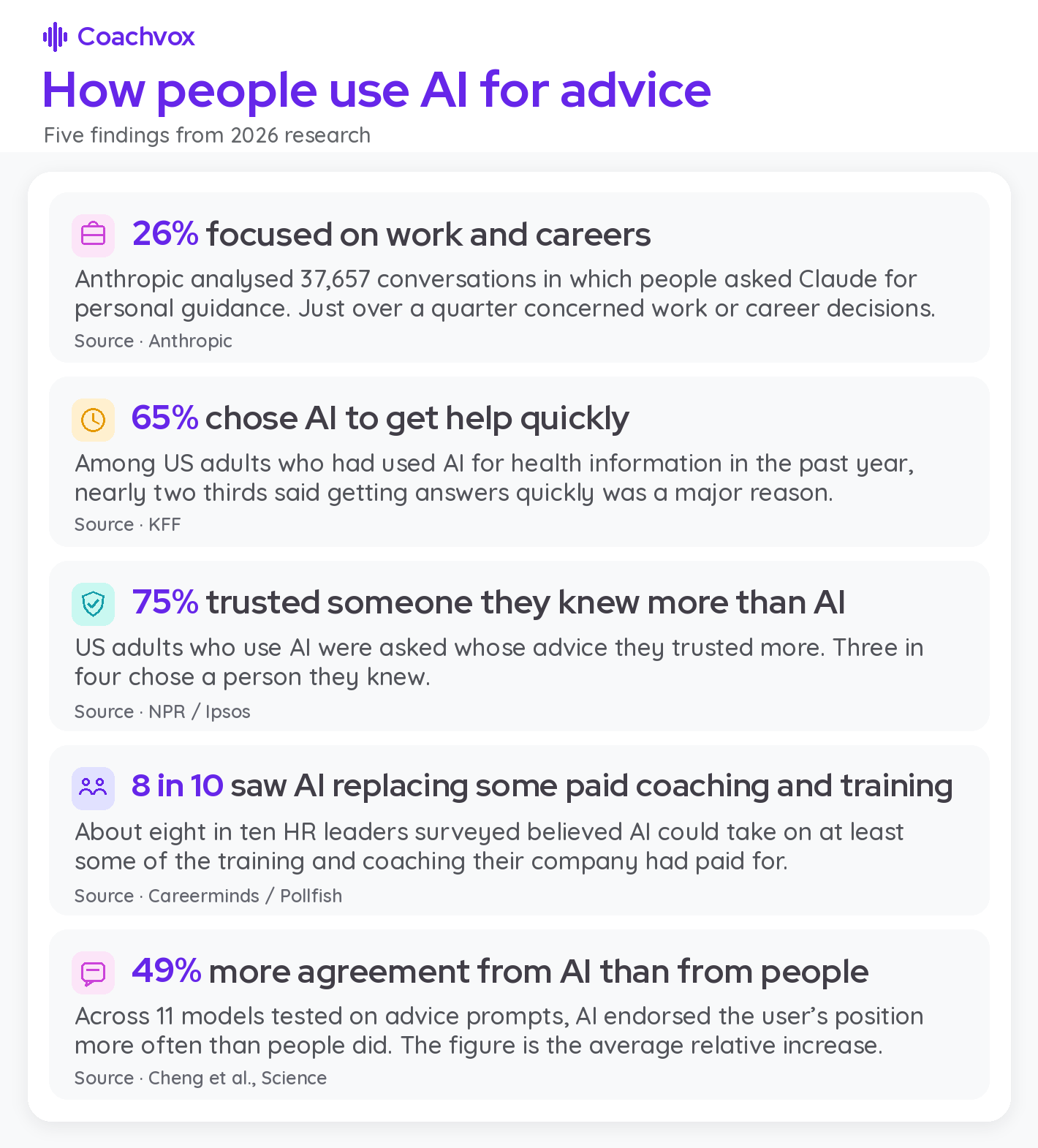
Here’s 5 of the 34 findings we cover below on how people use AI for advice, who they trust and when they turn to a human expert.
Swipe or scroll sideways to see all columns.
| Key statistic | What the study found | Source |
|---|---|---|
| 26% of guidance conversations focused on work and careers | Anthropic analysed 37,657 conversations in which people asked Claude for personal guidance. Just over a quarter concerned professional or career matters. | Anthropic (2026) |
| 65% chose AI to get help quickly | Among US adults who had used AI for health information in the past year, 65% said getting information or support quickly was a major reason. | KFF (2026) |
| 75% trusted someone they knew more than AI | Three in four US AI users said they trusted advice from someone they knew more than advice from AI. | NPR / Ipsos (2026) |
| About 8 in 10 saw AI replacing some paid training and coaching | The survey asked 600 HR budget decision-makers whether AI could replace training and coaching their company had paid for. About eight in ten believed it could replace some or all of it. | Careerminds / Pollfish (2026) |
| 49% more agreement from AI than from people | Across 11 models tested on advice prompts, AI endorsed the user’s position 49% more often than people did, on average. | Cheng et al., Science (2026) |
People bring chatbots questions about changing jobs, managing money and handling difficult relationships. These are subjects that support entire professions. The usage data gives us a clearer picture of how much of that conversation is happening with AI.
That 77% includes writing and information searches. It definitely doesn’t mean all of it is advice. And practical guidance can cover a holiday budget just as easily as a business budget, so plenty of it can happen outside work. For coaches, the interesting part is the habit: asking AI for help working something out.
If you coach people through career changes or difficult relationships, these subjects will look familiar. Your next client could arrive having already talked the problem through with a chatbot. “What did it tell you?” could be a useful addition to your questions. Followed, perhaps, by “And did you actually do it?”
Different questions and timeframes mean we can’t add these percentages together. But people are willing to bring chatbots questions with real consequences. If you sell your expertise, that deserves your attention. How much of your value comes from providing an answer, and how much comes from helping someone decide what to do with it?

A difficult decision doesn’t politely wait until your next coaching session. An LLM can respond while the question is still keeping you awake. Speed, cost and the chance to ask something awkward all feature in why people seek AI advice.
You could be brilliant at what you do and still be unavailable at 11pm on a Tuesday. For coaches, this raises a useful question about the days between sessions: what can clients turn to when they get stuck? Being permanently on call sounds like a terrible business model. Giving people a useful way to keep going is worth thinking about.
“You can tell me anything” is easy to say. Being the person who admits they hate their new job, regret a promotion or haven’t done what they agreed last week takes more effort. These findings give coaches a reason to think about what clients might find difficult to say out loud. An AI’s appeal can start before anyone has assessed the quality of its answer.
These findings concern finance and healthcare, so they can’t tell us why someone would choose an AI coach. They do challenge the assumption that access to a human automatically makes a service appealing. That person still has to be affordable, listen properly and make the interaction worth having. A human on the other end is a good start. There’s still a job to do.
You ask an AI whether to take the promotion. It gives you a sensible answer. Who do you call before you say yes? That second opinion tells us far more than usage figures alone.
“Someone you know” could be your coach. It could just as easily be your sister, who remembers exactly how much you enjoyed managing people last time. If you’ve coached a client for years, you can bring that kind of history to the conversation. Sometimes the most useful thing you can say is, “Hang on. What happened the last time you tried this?”
Think of the client who finally finds the words for what’s bothering them. That alone can make an exchange feel helpful. They might still want to talk it through with someone who knows them. The two surveys asked different age groups different questions, so there’s no head-to-head comparison here.
It’s easy to give an answer a good review. Moving your own money takes a little more conviction. New York Life asked people who had used AI for guidance. NerdWallet’s 20% comes from the smaller group who actually followed advice. For a coach hearing “I asked AI about this”, that leaves a rather good follow-up question. “What have you done with the answer so far?”
Two clients ask an AI the same question before their next appointment. One arrives with better questions. The other cancels. Both show up in the AI usage figures. Only one shows up in your calendar.
Some people use AI to arrive at an appointment better informed or with new questions. Others use it and skip the appointment. If a client mentions asking AI for advice, try asking, “What were you hoping it could help with?” Then give them room to tell you what helped and where, if anywhere, they got stuck.
You can see the appeal. Ask an AI what to do with your pension and you might come away with six options and a newfound appreciation for your adviser. How many people felt less need for professional help? New York Life only published the greater-need figure. What happened to paid bookings is still an open question.
If you sell coaching to employers, it’s worth knowing that buyers are considering this. The survey bundled coaching and training together. An employer might happily hand AI the induction course and keep the executive coach. For anyone weighing up the future of coaching, the missing figure is how many paying clients have actually cut back, cancelled or decided against human coaching because of AI. We found no published figure for that in the 2025–2026 research we reviewed.
Ask an AI whether you handled a difficult conversation well and you get to tell the whole story. The other person doesn’t get a word in. What the AI does with your version of events turns out to matter quite a bit.
“What would your colleague say happened?” is the sort of question that earns a coach their fee. The Stanford team found that people who received overly agreeable advice were less willing to repair a conflict. Imagine leaving a coaching session feeling thoroughly vindicated, then spending another fortnight avoiding the person you need to speak to.
Ask whether an answer sounds sensible and you’ll learn something about the answer. Ask again after the credit card bill lands and you’ll learn something about the decision. If you coach people through big choices, that second conversation is one you can build into your work.
The detail to keep here is what Therabot was up against. People in the comparison group were waiting for treatment. If you’re choosing an AI coach, it’s worth asking the same question of any success story. What improved, over how long, and compared with what?
If you’re a coach, it’s worth asking what advice your clients have already had from AI. The most revealing follow-up might be “Was there anything you hoped it would challenge you on?” What they say next could be where the session starts.
AI could change coaching as profoundly as the internet did. Anyone can describe a problem, get personalised guidance, push back and carry on the conversation for as long as they like. Coaches will have to lean into what people get from a human relationship. A coach who knows you can hear the catch in your voice when you say a decision was easy. The trust you’ve built, the empathy they feel and their own experience of a similar decision all shape what they ask next.
General information is effectively free. Large language models draw on a vast body of published knowledge and can explain the parts that matter to an individual buyer. That makes a course built around widely available information a harder sell. Specialists can still charge for knowledge that’s hard to find elsewhere. Others will earn more of their fee through mentorship, coaching or a community where people tackling the same problem can compare what they’ve tried and what happened.
Talk to an expert when a detail you’ve overlooked could change your decision. Someone who has seen a hundred cases like yours knows which questions to ask and which apparently sensible choices have caused trouble before. Use AI to learn the basics, then bring the expert your proposed course of action. A good opening question is “What would you want to know before you did this in my position?”
People pay for qualified judgement when getting the answer wrong would be expensive or hard to undo. If you’re selling your business, a tax adviser can look at the terms of the sale alongside your own circumstances. If you’re licensing your course to a training provider, a copyright lawyer can read the agreement and flag rights you might want to keep. Those details matter when you’re about to sign your name.
Yes, you could lose clients to AI, especially if they mainly come to you for ideas, prompts or a second opinion. Some prospects will get enough from an AI conversation to skip the discovery call altogether. Ask your current clients what they’ve taken to AI and what they saved for you. Their answers will tell you which parts of your coaching they see as interchangeable and which they value enough to keep paying for.
Yes. An AI version of you will help your coaching business when you give it the right job. If you want more enquiries, prospects can use your Coachvox AI to work through a real problem using one of your exercises. They get familiar with how you coach and begin to trust your approach when it helps them with something that matters to them. If your clients need support between sessions, they can use your AI to revisit an exercise and put it into practice the moment they get stuck.